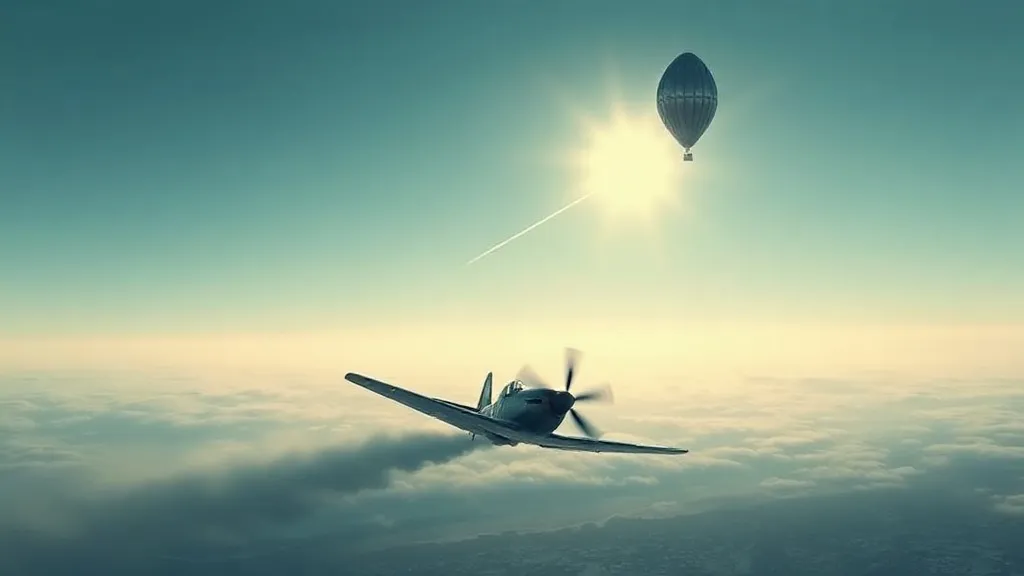
Captain Thomas Mantell radioed that a 'metallic object of tremendous size' hung above his fighter, then blacked out from lack of oxygen and crashed. The Air Force first blamed the planet Venus, then a classified Navy balloon he had no way of knowing existed.
Just after noon on January 7, 1948, the control tower at Godman Army Airfield in Kentucky was fielding calls about a strange object hanging in the winter sky. When four Air National Guard pilots passed nearby, three were asked to take a look. What followed made Captain Thomas Mantell, a 25-year-old decorated World War II veteran, the first person on record to die while chasing a UFO.
The answer, settled years later by the Air Force’s own investigators, was almost as strange as a spacecraft would have been. Mantell had most likely chased a Skyhook balloon: a classified Navy research craft so secret that he had no way of knowing it existed. He climbed after it in an unpressurized fighter, ran out of breathable air, and lost consciousness.
A climb with no oxygen
Mantell’s radio calls survive in the case record. At 14,000 feet he reported the object “directly ahead of me and above me now, moving at about half my speed,” according to a U.S. military account of the incident published by the Defense Visual Information Distribution Service. Moments later, at 15,000 feet, he described “a metallic object … of tremendous size.”
His two remaining wingmen broke off at around 22,000 feet. Their P-51 Mustangs (by then redesignated F-51s) carried no oxygen equipment, and above roughly 20,000 feet a pilot cannot stay conscious for long on cabin air alone. Mantell kept climbing anyway. His transmissions stopped. The Air Force concluded he lost consciousness from oxygen starvation near 25,000 feet, and his unpiloted aircraft spiraled down and crashed in the Kentucky countryside.
From Venus to a secret balloon
The first official explanation did not hold up. Project Sign, the Air Force’s earliest UFO study and a forerunner of Project Blue Book, suggested Mantell had chased the planet Venus, which can shine brightly even in daylight. The astronomer who floated that idea, J. Allen Hynek, later withdrew it, noting that Venus was not bright enough that afternoon to explain what the witnesses described.
By 1952, Captain Edward Ruppelt, then heading Blue Book, reached a different conclusion. Ground observers had reported an object that looked, in one account, like “an ice cream cone tipped with red,” and an astronomer at Vanderbilt University reported a “pear-shaped balloon with cables and a basket attached.” Those are not descriptions of a spacecraft. They match a Skyhook - one of the giant polyethylene research balloons the Navy was quietly launching to sample the upper atmosphere. Rising as high as 100,000 feet and gleaming metallic in sunlight, a Skyhook could look enormous, nearly motionless, and utterly foreign to anyone not briefed on the program.
That last point is the heart of the case. Skyhook was classified. Mantell was chasing something real, but the explanation for it was locked inside a program he was not cleared to see. It is the same trap that still catches observers today, and a large part of why so many sightings turn out to be ordinary or secret objects seen under unusual conditions.
Why the death mattered
Mantell died about six months after the Roswell headlines, and the combination proved potent. Here was a trained military pilot, killed while pursuing a “flying saucer,” at a moment when the country was primed to believe. The historian David Michael Jacobs has argued that the fact a person had died in an encounter with an alleged saucer sharply increased public concern about the phenomenon.
The secrecy made it worse. Because the balloon program stayed hidden, the vacuum filled with rumor - that Mantell had been shot down by a hostile craft, or that the Air Force was hiding a lethal encounter. In reality the tragedy was more mundane and more human: a pilot fixed on a target he could not identify, climbing past the edge of what his aircraft and his lungs could survive.
The pattern set in 1948 would repeat for decades. Official reticence, whether from genuine classification or simple caution, tends to breed the very theories it hopes to avoid, a dynamic that later pushed the government toward quietly debunking sightings rather than explaining them. The catch, worth stating plainly, is that no document has ever positively matched a specific balloon launch to Mantell’s sighting. The Skyhook explanation is by far the best supported, but the final sliver of the case remains, like the man himself, just out of reach.