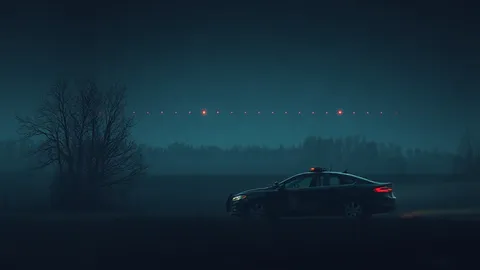
Betty and Barney Hill said a craft followed their car through the White Mountains, and that two lost hours hid an examination aboard it. The case still shapes how we picture aliens - and how scientists weigh memories recovered under hypnosis.
Late on the night of September 19, 1961, Betty and Barney Hill were driving home to Portsmouth, New Hampshire, after a short vacation in Niagara Falls and Montreal. Somewhere south of Lancaster, on a dark stretch of U.S. Route 3 through the White Mountains, Betty noticed a bright point of light that seemed to move against the stars. Through binoculars, she later said, it resolved into an odd-shaped craft with multicolored lights, drifting near the face of the Moon.
What the Hills reported next turned an ordinary drive into the founding story of an entire genre. According to accounts they later gave investigators, the object descended, Barney stopped the car near Indian Head, and through binoculars he saw eight to eleven figures watching him from behind windows. He fled in terror. The couple reached home near dawn, and a 178-mile trip that should have taken about four hours had somehow taken seven. Neither could clearly remember roughly 35 miles of the road.
That gap - two missing hours - is the seed of the modern alien-abduction narrative. But the most careful reading of the evidence, including the judgment of the couple’s own psychiatrist, points away from a literal trip aboard a spacecraft and toward something stranger and more human: a memory assembled after the fact.
What the Hills said happened
The Hills were not fringe figures. Barney was a U.S. Postal Service employee and an active NAACP member; Betty was a social worker. They were an interracial couple at a time when that was uncommon and often dangerous in the United States, and friends described them as level-headed. About a month after the sighting, on October 21, 1961, they reported it to Walter Webb, an investigator with the civilian UFO group NICAP, per the case record later archived at the University of New Hampshire, which today holds the Betty and Barney Hill Papers.
Roughly ten days after the drive, Betty began having vivid dreams on five successive nights. In them, small men in matching uniforms took her aboard a craft and examined her. For nearly three years the couple carried a lingering anxiety and a blank in their memory of the trip. Then, in 1963 and 1964, Boston psychiatrist Dr. Benjamin Simon treated them with hypnosis, meeting each of them separately so their accounts could not cross-contaminate. Under hypnosis, both described being taken aboard and examined, and Betty recounted a conversation with a “leader” who showed her a three-dimensional map of stars and trade routes.
John Fuller’s 1966 book “The Interrupted Journey” made the case a bestseller, and the 1975 NBC film “The UFO Incident,” starring James Earl Jones and Estelle Parsons, fixed it in popular memory. The Air Force’s Project Blue Book had logged the original light, but the abduction, drawn out only under hypnosis years later, was never the kind of thing a government file could confirm or close.
Why the evidence points to memory, not a spaceship
Here is the detail that rarely survives the retellings: Dr. Simon did not conclude his patients had been abducted. He judged the episode “a singular psychological aberration,” and attributed the vivid abduction account largely to Betty’s earlier dreams rather than to a real event. Hypnosis, as decades of research have since shown, does not unlock buried footage. It can just as easily help a suggestible person assemble a detailed, sincerely believed memory of something that never happened. That is the same ground covered in the science behind sleep paralysis and abduction reports.
The famous star map fares no better under scrutiny. In 1968 an amateur astronomer and schoolteacher, Marjorie Fish, built wire-and-bead models of nearby stars and reported that Betty’s sketch matched the Zeta Reticuli system, about 39 light-years away. But the Armagh Observatory and Planetarium notes that Fish was matching a memory of a dream, that hundreds of stars sit within the search volume so a rough correspondence is nearly inevitable, and that better distance measurements from the Hipparcos satellite dissolved the pattern. Fish herself, to her credit, later withdrew the claim. Even the look of the beings has a possible earthly source: the skeptic Martin Kottmeyer noted that an episode of “The Outer Limits” featuring a wraparound-eyed alien aired just twelve days before Barney first described his captors under hypnosis.
None of this proves the Hills invented anything. They appear to have genuinely seen a light they could not explain, and to have genuinely suffered for it. What the case shows, more than sixty years on, is how quickly a real fright and a suggestive method can harden into a memory that feels like fact. It is why modern investigators, as we cover in how scientists actually study UAP, now lean on instruments and calibrated data rather than recovered testimony - and it is why the Hill case, the one that started it all, endures as a study of the mind as much as the sky.