Sensor artifacts, data gaps, and rigorous methodology - what does it really take to turn a puzzling sky sighting into a scientifically useful data point? Researchers explain.
When an aircrew reports an object that appears to defy known aerodynamics, or a radar operator records a target moving at speeds that challenge any known propulsion system, the natural human impulse is to ask: what was it? But for scientists, the prior question is more fundamental - and more demanding: is the observation itself reliable?
That distinction sits at the heart of how serious researchers approach anomalous aerial phenomena. The answer to “what was it” is only as good as the underlying data, and most existing UAP data, by the assessment of leading researchers, is deeply inadequate.
The Data Problem
In September 2023, NASA released the final report of its independent UAP study team - a panel of 16 experts across astronomy, oceanography, aerospace, artificial intelligence, and data science, chaired by astrophysicist David Spergel, president of the Simons Foundation and former chair of Princeton’s astrophysics department.
The team’s central finding was not about any specific phenomenon. It was about data. “Scientists do not presently have the body of data needed to make definitive scientific conclusions about UAP,” the report stated. Of the more than 800 unclassified sightings collected by AARO - the Pentagon’s All-domain Anomaly Resolution Office - only a small number could not be immediately attributed to known human-made or natural phenomena. But even those residual cases resisted analysis because the observational data was incomplete, uncalibrated, or captured by a single sensor without corroboration.
This is a structural problem. Most UAP observations are opportunistic - a pilot’s cockpit camera, a ship’s infrared sensor operating in conditions it was not designed to document. There is rarely the multi-instrument, calibrated, metadata-rich capture that would allow a scientist to rule out sensor artifacts or atmospheric effects before asking harder questions.
What Good Data Looks Like
Spergel’s team recommended that NASA leverage its existing assets and partnerships to build what currently does not exist: a systematic, calibrated data infrastructure for UAP. Specifically, the team called for using Earth-observing satellite constellations, commercial remote sensing data, and standardised sensor metadata to create observations that can be independently assessed.
The recommendations centre on a concept familiar to any working astronomer: reproducibility and calibration. An anomaly detected by one sensor in one pass is a curiosity. An anomaly detected consistently across multiple independent sensors with matched timing, geolocation, and spectral data is the beginning of a scientific case.
Sensor artifacts are a persistent concern. Infrared cameras used by military aircraft can produce “blooming” effects on fast-moving or high-contrast targets. Radar systems have characteristic ghost returns under certain atmospheric conditions. Even the human visual system - the most common “sensor” in eyewitness UAP reports - is well documented to misperceive size, speed, and distance of unfamiliar objects at altitude, particularly against a uniform sky background.
The Galileo Project Approach
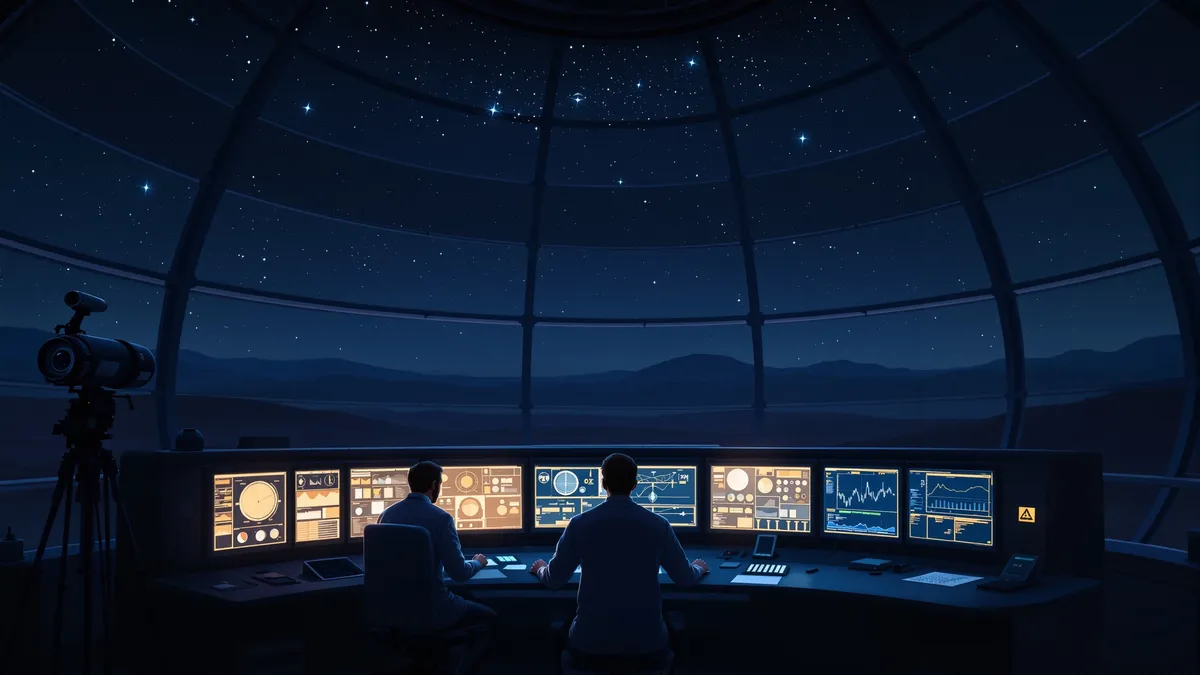
Independent of government initiatives, Harvard astrophysicist Avi Loeb launched the Galileo Project in July 2021 with the explicit goal of studying UAP through purpose-built scientific infrastructure. The project operates multiple ground-based observatories equipped with cameras, audio sensors, and radio receivers that continuously monitor the full sky in optical, infrared, and radio bands.
The Galileo Project published its first seven peer-reviewed scientific papers in the Journal of Astronomical Instrumentation, establishing its methodological baseline. Machine learning algorithms trained on millions of labelled objects - birds, balloons, commercial drones, satellites - form the classification layer. The approach treats UAP detection as essentially an anomaly-detection problem: identify and characterise the known population thoroughly enough that genuine outliers stand out statistically.
The project operates observatories in Massachusetts, Pennsylvania, and Nevada. The Nevada site, the most advanced, was established in 2025 and is designed to instrument the full sky simultaneously across multiple spectral bands.
The Stigma Factor
Both NASA’s report and the Galileo Project’s published rationale address a sociological dimension of the data problem: stigma. For decades, military pilots and civilian aviators who reported anomalous aerial sightings risked professional consequences. Formal reporting channels were unclear or discouraging. The result was a systematic undercounting of observations and a disinclination to document encounters rigorously in the moment.
NASA explicitly called for destigmatising UAP reporting as a prerequisite for better data. The agency appointed Mark McInerney as Director of UAP Research in September 2023, with a mandate to centralise data resources and coordinate with other agencies.
What Scientists Are Not Claiming
A recurring point of agreement across the scientific literature and official reporting is what has not been established. NASA’s study team found no evidence of extraterrestrial origin for any observed phenomena. AARO’s historical record report, published in March 2024, similarly found no empirical evidence of alien technology in the cases it reviewed.
Neither finding amounts to proof that all UAP are mundane - absence of evidence is not evidence of absence, particularly when the evidence base is as thin as researchers acknowledge it to be. What the science does establish is a research programme: the path forward is instrumented, systematic data collection, not leaps to conclusions from anecdotal accounts. That is a less dramatic story than headlines often suggest, but it is the honest one.