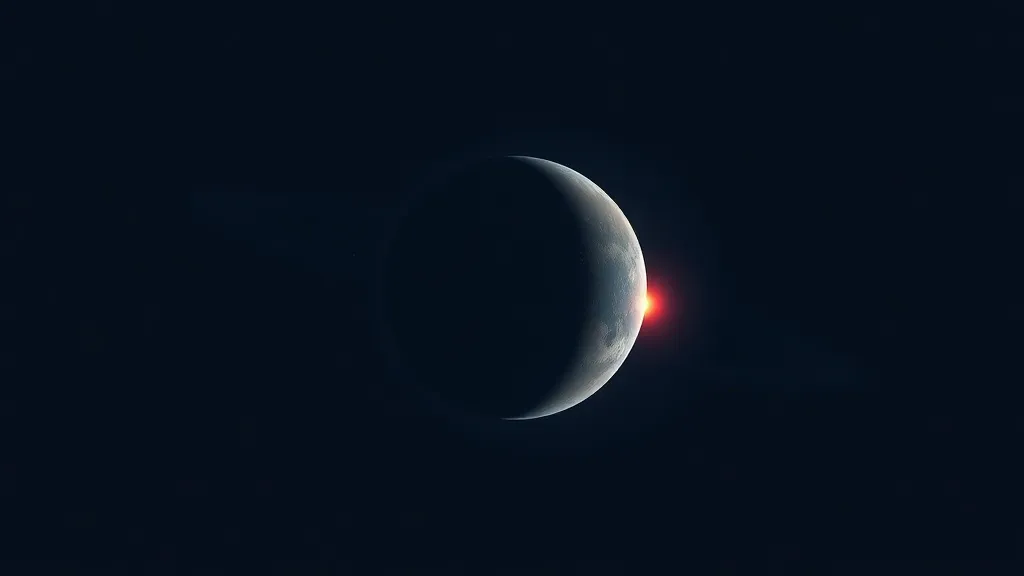
Using a telescope in Chile, scientists detected helium escaping from LHS 1140 b - a super-Earth sitting exactly where liquid water could exist on a rocky surface. It is the first rocky habitable-zone world confirmed to hold any atmosphere at all.
During a single night in 2024, a team of astronomers at a mountaintop observatory in Chile watched a rocky planet drift across the face of a dim red star 48 light-years from Earth. As the planet passed, it blocked a sliver of starlight - and embedded in that sliver was something scientists had never seen before: the unmistakable fingerprint of helium leaking from an alien atmosphere.
That detection, published July 16 in the journal Science by a team led by Collin Cherubim of the Center for Astrophysics at Harvard and the Smithsonian, marks the first time astronomers have confirmed an atmosphere clinging to a rocky planet in another star’s habitable zone - the band of orbital distances where conditions are right for liquid water to exist on a surface.
“This is the first time anyone has found an atmosphere on a rocky planet in the habitable zone of another star,” said Robin Wordsworth of Harvard University, a co-author on the study.
The planet is LHS 1140 b, a super-Earth discovered in 2017 that has long been considered one of the most promising candidates in the search for life beyond our solar system. A super-Earth, in planetary science terms, is a rocky world larger and heavier than Earth but not large enough to become a gas giant. LHS 1140 b has about 5.6 times Earth’s mass and 1.7 times its width, and it orbits its host star - a red dwarf (a small, cool star far dimmer than our Sun) - every 24.7 days.
How Scientists Found the Air
The detection relied on a spectrograph - an instrument that splits starlight into individual wavelengths, the way a prism turns white light into a rainbow. When LHS 1140 b passed in front of its star, the researchers used the WINERED (Warm Infrared Echelle spectrograph to Realize Extreme Dispersion) instrument on the Magellan Clay Telescope at Las Campanas Observatory in Chile to analyze the starlight filtering through the planet’s outer layers.
The light dimmed at a specific wavelength - the one absorbed by helium. That dip, the team concluded, means helium is present in the planet’s uppermost atmosphere and slowly escaping into space.
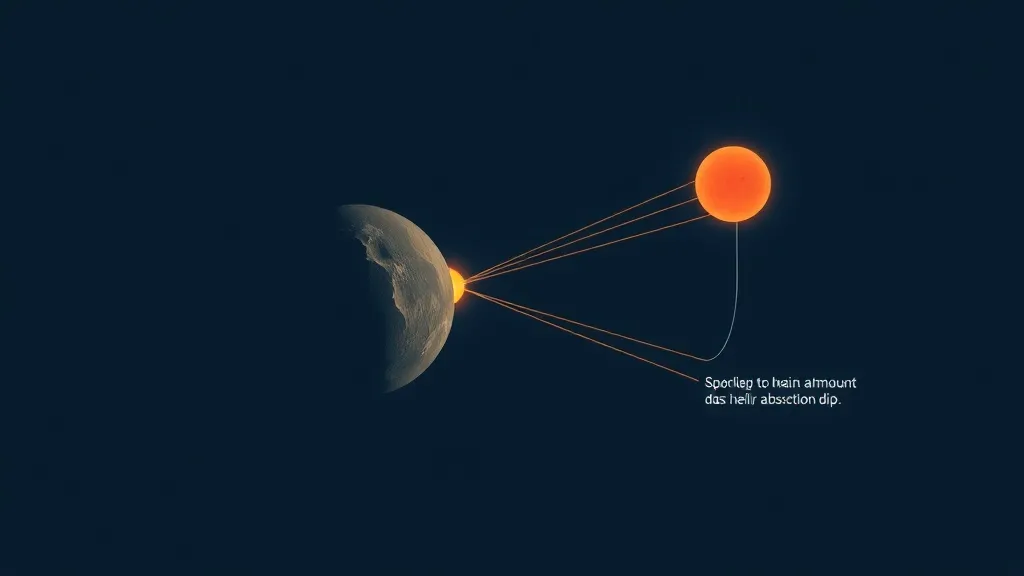 Why helium in particular? Lighter gases tend to rise to the top of an atmosphere because heavier molecules - including water vapor, carbon dioxide, and nitrogen - settle deeper down under gravity. Finding helium leaking outward suggests there could be heavier, potentially life-supporting gases trapped below it, according to the research team. “The exciting part about this paper, and why I think it was accepted into Science, was that this is the first time that we’re seeing a rocky, Earth-like planet that could still have an atmosphere,” said co-author Jason Dittmann of the University of Florida.
The Catch - and the Question It Raises
The picture is not straightforward. When the team looked again in 2025 using the same instrument, no helium signal appeared - the escaping gas had gone quiet.
That inconsistency suggests the outgassing is variable, possibly driven by bursts of X-ray and ultraviolet radiation from the host star, which can strip atmospheric gases more aggressively during periods of heightened stellar activity. “The atmospheric escape appears to be variable,” said Shreyas Vissapragada of Carnegie Science Observatories, a co-author. “It is a rare privilege to witness the atmosphere of an extrasolar planet change on such short, human timescales.”
The variability introduces a genuine uncertainty. One possibility is that LHS 1140 b sustains a stable, long-lived atmosphere whose uppermost helium layer periodically vents in response to the star. The other is that the planet is a geologically active bare rock that occasionally releases gas from its interior - no stable atmosphere, just intermittent puffs. The data so far cannot rule out either scenario.
What Comes Next
To resolve the question, the team plans to use the James Webb Space Telescope (JWST) over the next four to five years to search for water vapor in the planet’s lower atmosphere. Water absorbs infrared light at well-known wavelengths, making it detectable by JWST even across 48 light-years.
If water vapor appears in the data, it would indicate a stable atmosphere that has persisted over geological time - the strongest evidence yet that a rocky planet in a habitable zone can maintain the conditions needed for life as we know it.
If no water is found, the helium signal may reflect something more limited: a volcanically active world that releases gas without sustaining the thick, stable blanket that life requires.
Either way, detecting any atmospheric signal at all on a small, rocky world in exactly the right orbital zone is a significant technical achievement. For years, atmospheric searches on exoplanets focused on gas giants and Neptune-sized worlds because their thick atmospheres produce strong, readable signals. Pulling a clear helium fingerprint from a rocky planet nearly five times smaller is a different challenge entirely.
“Now we know at least one has,” Wordsworth said - referring to rocky habitable-zone planets with atmospheres. The search for what lives inside that atmosphere is, for the first time, a question science can begin to test.