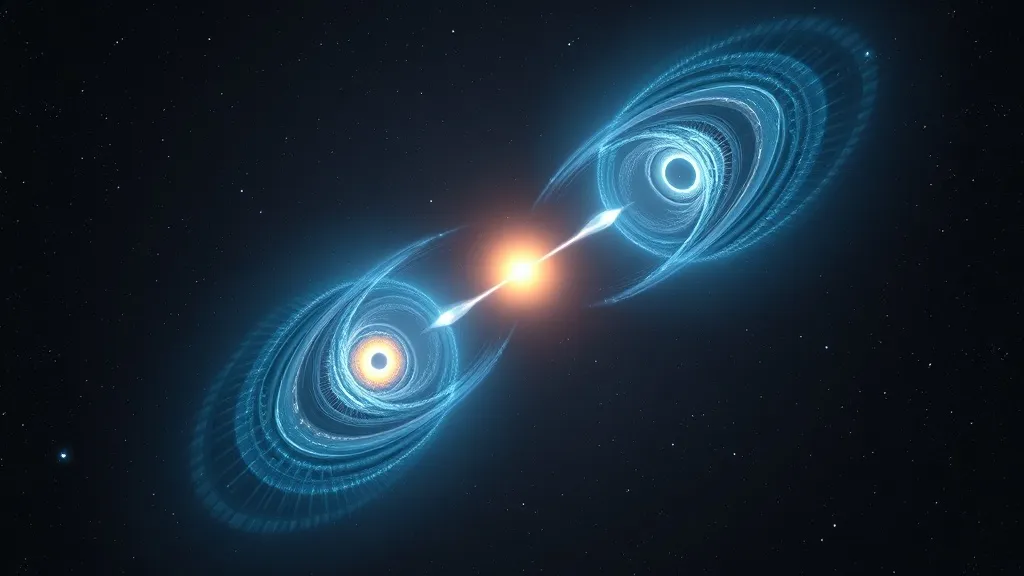
Using XMM-Newton and NuSTAR, researchers detected two layered wind components moving at 10% and 30% the speed of light from a 2-billion-solar-mass black hole 11 billion light-years away - the most distant ultra-fast outflow ever caught in a non-lensed quasar.
When astronomers using the European Space Agency’s XMM-Newton telescope announced they had spotted a “UFO” near a distant black hole, they were not joking - but they were also not talking about alien spacecraft. In astrophysics, “UFO” stands for Ultra-Fast Outflow: a torrent of X-ray-emitting gas that streams away from a supermassive black hole at speeds exceeding 10% of light itself.
The UFO found near the quasar WISSH13, described in a June 2026 preprint led by Giorgio Lanzuisi of INAF Bologna, is not just any outflow. According to the research team, it is the highest-redshift UFO ever detected in a quasar that is not artificially brightened by gravitational lensing - and one of the most energetic ever observed anywhere in the universe.
Two Winds, One Black Hole
The team used simultaneous observations from XMM-Newton and NASA’s NuSTAR X-ray telescope to study WISSH13, a hyper-luminous quasar - a term meaning an extraordinarily bright galaxy core powered by a feeding supermassive black hole - located at a redshift of z=3.294. That figure places it roughly 11 billion light-years from Earth, meaning we are seeing it as it existed about 2 billion years after the Big Bang.
Astronomers call that period “cosmic noon”: the epoch when galaxies across the universe were forming stars at the highest rate ever recorded. WISSH13’s central black hole weighs roughly 2 billion times the mass of our Sun and is consuming surrounding gas so rapidly that it is described as “super-Eddington” - eating faster than most theoretical models predict should be sustainable.
What makes this observation stand out is the layered structure of the outflow the team uncovered. Rather than a single uniform wind, the XMM-Newton and NuSTAR data reveal two distinct components moving at strikingly different speeds. The outer layer - which the researchers describe as a “sheath” - travels at roughly 10% of the speed of light, or about 30,000 kilometres per second. The inner “spine” moves nearly three times faster, at approximately 30% of the speed of light, around 90,000 kilometres per second.
Together, the two components are ejecting somewhere between 20 and 24 solar masses of material every year.
Why a Black Hole “Blows Its Own Fuse”
These outflows are not mere spectacle. Astrophysicists have long suspected that ultra-fast outflows are one of the key mechanisms through which supermassive black holes regulate both their own growth and the evolution of the galaxies that host them - a process called AGN feedback (AGN stands for Active Galactic Nucleus, the technical term for the energised core powered by a feeding black hole).
The mechanism works roughly like this. A growing black hole generates powerful X-ray winds that radiate outward from the surrounding accretion disk - the swirling disc of gas being consumed by the black hole. Those winds carry enormous kinetic energy into the surrounding galaxy. Over time, they heat the gas that would otherwise collapse to form new stars, push that gas outward, and gradually starve the galaxy of the raw material it needs for further star formation. At sufficient power, the feedback can quench star formation across an entire galaxy over billions of years.
The combined kinetic power of WISSH13’s two outflow components amounts to roughly 1 to 10% of the quasar’s total luminosity. According to the team’s analysis, that range falls within the threshold required for AGN feedback to meaningfully affect the host galaxy’s star formation - not merely dissipate harmlessly into intergalactic space.
What makes the WISSH13 result particularly significant is timing. Catching an outflow this powerful at cosmic noon - the universe’s most productive era for star formation - suggests the feedback loop was already operating efficiently when galaxies were at their busiest, not just in a later, quieter universe where most comparable outflows had previously been detected.
What Comes Next
The findings are currently a preprint submitted to the arXiv repository and have not yet completed formal peer review. They are part of the WISSHFUL program - a multi-year XMM-Newton heritage initiative designed to survey the X-ray properties of hyper-luminous quasars across the early universe.
WISSH13 is one object in a larger population of extreme quasars. Whether the two-component “sheath and spine” architecture seen here is common among hyper-luminous quasars at this epoch, or whether WISSH13 is an outlier, will require catching more such systems in simultaneous broadband X-ray observations - something the WISSHFUL program is designed to do over the coming years.
For now, the irony is worth appreciating: the most exotic thing astronomers found near this distant black hole turns out to be exactly what they were looking for. It just happened to come with an acronym that makes you look twice.