Named MoM-BH*-1, it shines like 100 billion Suns yet carries the light signature of a single star. MIT researchers say the best explanation is a black hole cloaked in a solar-system-sized shell of hydrogen - and that Webb's 'little red dots' may be the same thing.
Astronomers aimed the James Webb Space Telescope at what looked like an ordinary bright galaxy from the dawn of time. What came back broke the rules for both stars and galaxies: a single, glaringly red point of light pouring out as much energy as 100 billion Suns.
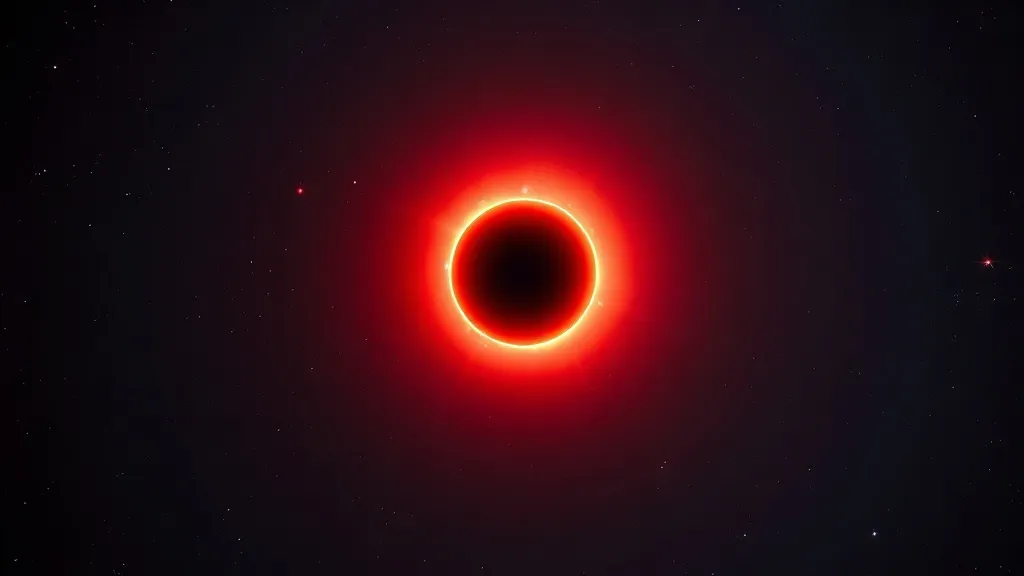
The best explanation, a team led by researchers at MIT reported on August 12 in the journal Nature, is something no one had confirmed before - a “black hole star.” In their model, the object is a black hole roughly 100,000 times the mass of the Sun, wrapped in a cocoon of hydrogen gas so large it glows like a giant star. They named it MoM-BH*-1, and the label “black hole star - one” hints they expect it is the first of many.
If the interpretation holds, it is a genuinely new class of object, and it may crack one of Webb’s most stubborn mysteries.
How a ‘Miracle’ Became a ‘Mirage’
The find was almost an accident. Rohan Naidu, a NASA Hubble Fellow at MIT’s Kavli Institute, and his colleagues were running a survey they called “Mirage or Miracle” (MoM), hunting for the earliest, most distant galaxies. Some of those ultra-bright specks are genuine early galaxies - the “miracles.” Others, the team found, are something else.
“What looks like an extremely bright early galaxy, aka a ‘miracle,’ in some cases actually could be a ‘mirage,’” Naidu said, according to MIT.
The giveaway was in the object’s light. Its spectrum showed an unusually deep “Balmer break” - a sharp drop in brightness at a specific wavelength that normally signals a dense atmosphere of ordinary stars. “The break we observed in this object is the deepest break we have ever observed in any object, ruling out ‘ordinary’ stars as the source,” Naidu said.
That created a paradox. The light carried the fingerprint of a star, but no star can shine that brightly. “You can’t be powering this by nuclear fusion, which is the energy source that sits at the heart of all the stars we have,” Naidu said. Fusion has a hard ceiling, and 100 billion Suns’ worth of output sails past it.
A Black Hole Wearing a Star’s Disguise
The team’s answer threads the needle. Picture a black hole at the center, feeding voraciously and releasing enormous energy as gas spirals in - the same engine that lights up a quasar. Now wrap it in a dense shell of hydrogen roughly the size of our solar system. The shell soaks up the black hole’s light and re-emits it, so from a great distance the whole thing looks and reads like one impossibly large star.
“We think there is a central black hole that is 100,000 times as massive as the Sun,” Naidu said. “And around this black hole, there would be this very extended envelope of gas that looks like a star.”
Two other clues fit the picture. Astronomers usually explain a very red object by assuming dust is reddening its light, but other signatures in the spectrum argued against dust. And the gas is nearly pristine - almost pure hydrogen and helium, with little trace of the heavier elements that accumulate over cosmic time. That is what you would expect a few hundred million years after the Big Bang, which is when this object existed.
Why It Might Explain the ‘Little Red Dots’
The bigger prize is a population, not a single oddball. Since Webb began peering into the early universe, it has turned up a whole population of “little red dots” - compact crimson specks that appear in nearly every deep image of the young cosmos, then largely disappear by the present day.
“These little red dots seem to be everywhere in the early universe but essentially disappear by the present day,” Naidu said. His team’s claim is sweeping: “Every little red dot is consistent with being a black hole star, embedded in a generic early galaxy.”
That would matter because the first giant black holes are a chicken-and-egg problem. Astronomers keep finding that supermassive black holes were already blazing as the oldest known quasars when the universe was a small fraction of its current age, and even flickering in the cosmic dawn. How they grew so massive so fast is unresolved. If little red dots are black holes in a hydrogen disguise, they could be the missing early stage - the same engine that drives a mature black hole’s ferocious outflows, caught bulking up before it announces itself as a quasar.
The case is not closed. The black hole star is a model that fits the data better than the alternatives, not a directly imaged object, and the underlying idea itself was proposed only recently. Naidu is candid about how fast the science is moving: “Our picture of this object is evolving very rapidly.” More Webb spectra, of MoM-BH*-1 and its many red cousins, will test whether astronomy has truly found a new kind of thing - or another mirage.