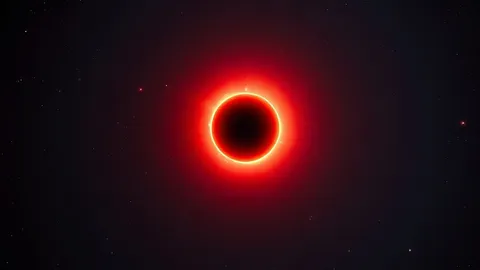
Using five years of ALMA radio data, researchers at Northwestern University have confirmed the first direct evidence of a wind blowing from Sagittarius A*, the supermassive black hole at our galaxy's center - resolving one of astrophysics' longest-standing predictions.
For more than 50 years, astrophysicists predicted that Sagittarius A* - the supermassive black hole at the centre of the Milky Way - must produce an outflowing wind, just as feeding black holes do across the observable universe. They had never been able to detect one. On June 4, 2026, that changed.
Researchers at Northwestern University’s Center for Interdisciplinary Exploration and Research in Astrophysics (CIERA) announced the first confirmed detection of a wind blowing from Sgr A*, the four-million-solar-mass black hole located approximately 26,000 light-years from Earth. The paper, authored by Mark Gorski and Elena Murchikova, was published in The Astrophysical Journal Letters.
The discovery does not indicate unusual or alarming activity at the galactic centre. According to the Northwestern University press release, Sgr A* is currently in a quiet phase - consuming relatively little material compared to actively feeding supermassive black holes observed in other galaxies. What the finding establishes is that even in this dormant state, the black hole is still expelling energy outward into the surrounding gas.
“Unless a black hole exists in a perfect vacuum, it must blow a wind somehow,” Gorski said, according to the Northwestern University press release. “We were not seeing the wind until now.”
What the data shows
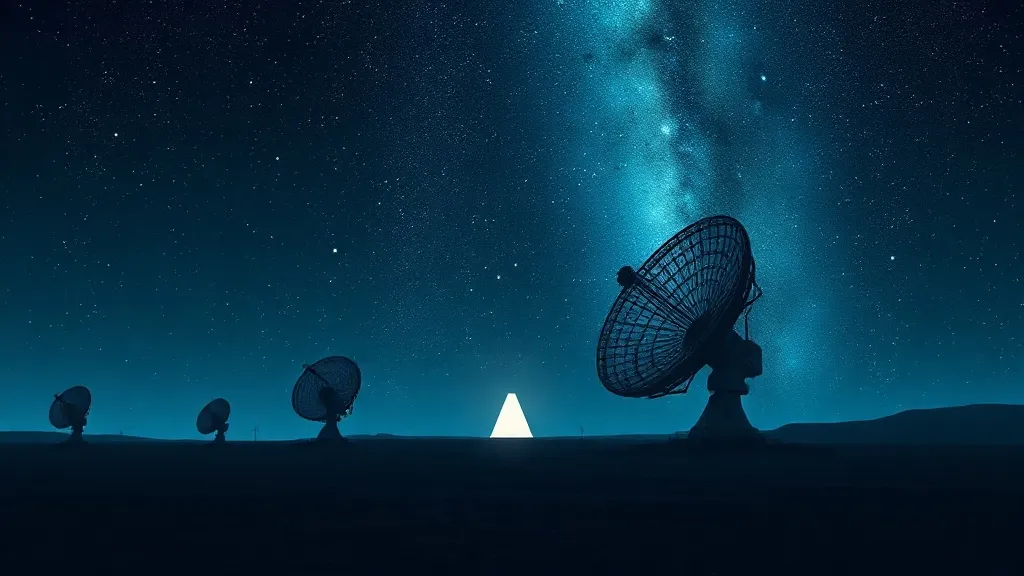
The research team used five years of observations from the Atacama Large Millimeter/submillimeter Array (ALMA), a high-altitude radio telescope complex in northern Chile operated by an international consortium, to map carbon monoxide emissions in cold molecular gas surrounding Sgr A*. By developing a novel data-processing technique that removed the black hole’s own bright and variable radio signals, the team produced images that the ALMA Observatory describes as 100 times more sensitive and 80 times sharper than any previous survey of the region.
The result was a clear cone-shaped cavity in the cold gas - approximately one parsec long (roughly three light-years) and 45 degrees wide - pointing directly toward the black hole. According to Northwestern University, this structure is the unmistakable physical signature of a sustained outward wind that has swept surrounding gas aside or heated it away over time.
The team cross-referenced the ALMA findings with archival data from NASA’s Chandra X-ray Observatory, which confirmed the presence of hot, energetic gas in the same region - consistent with an active outflow from the black hole’s accretion environment.
Murchikova described the character of the outflow as notably mild. “The wind is not powerful, and its direction probably wanders with time,” she said in the Northwestern University press release.
Based on the geometry and scale of the cavity, the research team estimates the wind has been active for at least 20,000 years, according to the published findings.
What remains uncertain
The study establishes the existence of the wind through indirect structural evidence: the cone-shaped void in cold gas is consistent with sustained outflow activity, but the findings do not constitute a direct recording of the wind as a flow. The precise physical mechanism driving the outflow - whether primarily radiation pressure, magnetic field processes, or other dynamics within the accretion environment - is not yet fully characterised, according to the paper.
The Astrophysical Journal Letters study does not characterise the wind as powerful or disruptive to the surrounding galaxy. The paper describes Sgr A* as a quiescent system, and the observed outflow is substantially weaker than the energetic jets produced by actively feeding supermassive black holes in other galaxies.
Why this matters
Sagittarius A* is the nearest supermassive black hole to Earth and, by extension, the one astronomers can study in the finest spatial detail. Confirming that even quiet, slowly accreting black holes produce winds has direct implications for theoretical models of how black holes influence the gas within their host galaxies and, over long timescales, how that feedback shapes galactic evolution.
“We usually see violent activities,” Murchikova noted, per Scientific American. “Seeing the black hole quiet but still dumping energy without doing anything violent, is terribly cute.”
The ALMA Observatory described the detection as confirming a foundational principle of black hole physics: that consuming even small amounts of gas is sufficient to drive an outward flow of material. The finding positions Sgr A* as a direct laboratory for studying this process - a laboratory no other black hole, by virtue of distance, can offer to the same degree.