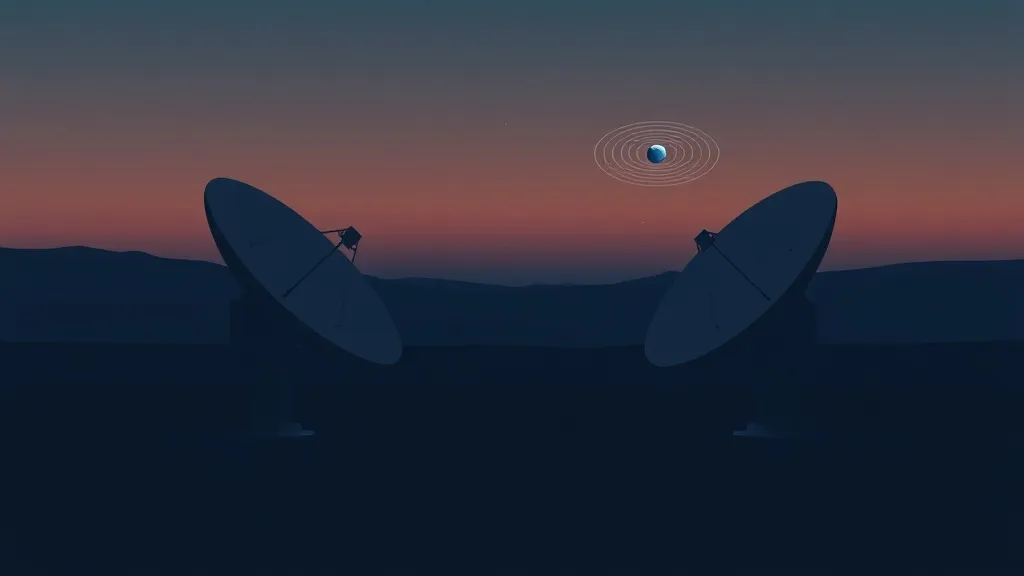
For at least one full 33-day orbit, the VLA and MeerKAT swept the famous exoplanet across radio frequencies sensitive enough to catch a trillion-watt beacon. A SETI team found no artificial signal - though they are careful about what that silence proves.
Of all the planets astronomers might scan for a message from another civilization, K2-18b is the one that would make headlines. It is the world where, in 2023, a team using the James Webb Space Telescope reported a faint chemical hint that some scientists read as a possible sign of life. So a group of radio astronomers did the obvious next thing: they pointed two of the world’s most sensitive telescopes at it and listened.
For at least one full orbit of the planet - a “year” on K2-18b lasts about 33 days - they heard nothing artificial. According to a study published in The Astronomical Journal, the search turned up no radio signal that could plausibly come from technology, in any frequency band or observing session.
That is not a disappointment so much as a first careful step. K2-18b had never been checked this way before, and the team is precise about what a quiet sky does and does not rule out.
Why point telescopes at this particular planet
K2-18b sits about 124 light-years away in the constellation Leo, circling a small, cool red dwarf star. It is a “sub-Neptune,” a little over twice Earth’s width and roughly eight times its mass, orbiting in the zone where liquid water could in principle exist.
What made it famous is its air. Webb’s observations found methane and carbon dioxide in the atmosphere, the kind of mix some models predict for a “Hycean” world - a planet wrapped in a hydrogen-rich atmosphere over a possible global ocean. The same 2023 analysis reported a tentative signal of dimethyl sulfide, a molecule that on Earth is produced almost entirely by marine life. That claim remains disputed - other teams have argued the data are too weak to support it - but it is why K2-18b became the exoplanet most associated with the phrase “possible biosignature.”
A biosignature, if real, would only suggest microbes or chemistry, not a civilization. Still, it makes the planet an obvious target for the other kind of search: not signs of life’s chemistry, but signs of its technology. That is what a technosignature is - a radio broadcast, a beacon, or leakage from machines, rather than the exhaust of biology.
What the silence actually rules out
The search, led by C.D. Tremblay of the SETI Institute, combined two instruments. The Karl G. Jansky Very Large Array in New Mexico observed the system across the autumn of 2023, and South Africa’s MeerKAT array added its own sessions, together covering frequencies from 544 megahertz to 9.8 gigahertz. Crucially, the observations were timed to span at least one complete orbit, so a transmitter facing Earth only during part of the planet’s year would still have had a chance to show itself.
Software then hunted for narrowband signals - the tight, single-frequency tones that nature rarely produces but transmitters do - and filtered candidates through a gauntlet of tests to strip out interference from Earth’s own radios and satellites. Nothing survived.
Here is the honest limit. The most sensitive part of the search could only have caught a beacon pouring out roughly a trillion watts of radio power aimed in our direction - comparable to the strongest planetary radar transmitters humanity has ever built, and far above the faint leakage of ordinary communications. As the authors write, “intermittent, broadband, or highly directional signals that did not illuminate the Earth at those times are not ruled out by this study.” In plain terms: a civilization that was quiet, or simply not pointing at us, would go unheard.
That is the recurring lesson of these searches. When SETI scanned interstellar comet 3I/ATLAS and sifted tens of millions of candidate signals, it also came up empty - a null result that narrows the possibilities without closing the question.
A rehearsal for a bigger machine
The value here is not only the non-detection. K2-18b joins a short list of specific, well-studied worlds now checked for technology as well as chemistry, alongside the growing catalogue of nearby planets on the roadmap for hunting biosignatures.
The team also treated the effort as practice. The automated filtering they built to separate a real signal from the roar of human interference is aimed at the next generation of radio observatories, including the enormous Square Kilometre Array, which will collect far more data than any person could inspect by hand.
For now, the most talked-about planet in the search for life has been asked a direct question and returned no answer. That silence is data, and the listening has only started.