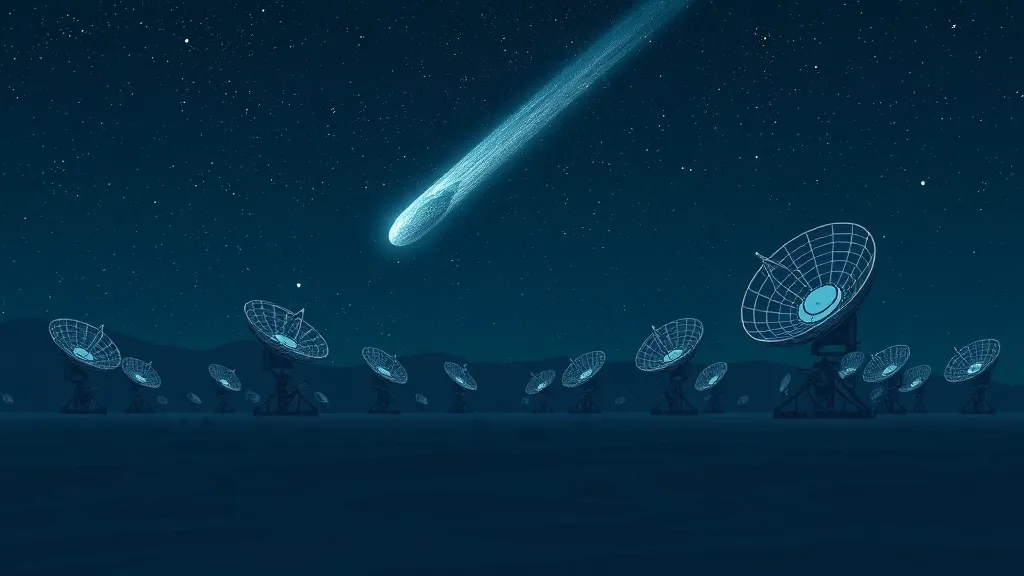
For the first time, astronomers had advance warning an interstellar visitor was approaching - and used it to scan 3I/ATLAS for alien tech. The Allen Telescope Array sifted 74 million signal candidates and found nothing artificial aboard.
In July 2025, a snowball from another star system entered the inner solar system. Within weeks, astronomers had a name for it - 3I/ATLAS, the third confirmed interstellar visitor in human history - and a plan for it. Not just to study its chemistry or photograph it, but to do something no one had ever managed before: aim a major radio telescope at an interstellar object and systematically scan it for signs of alien technology.
The result, published in The Astronomical Journal in June 2026, is clear. Scientists at the SETI Institute found no artificial radio signals from 3I/ATLAS. But the null result conceals a story worth telling, because the search itself made history.
When You Only Have One Chance
The two previous confirmed interstellar objects - 1I/’Oumuamua in 2017 and 2I/Borisov in 2019 - came and went before astronomers could mount anything like a coordinated SETI campaign. Both were detected late, leaving little time to organize dedicated observations. 3I/ATLAS, spotted far enough out that Earth had months of advance warning before closest approach, changed that.
Within days of its detection, the SETI Institute had secured observation time on the Allen Telescope Array - a field of 42 radio dishes at Hat Creek Radio Observatory in Northern California’s Cascade Mountains. The array is purpose-built for exactly this kind of search: listening across broad radio frequencies for narrowband signals, the kind of tight-frequency transmissions that nature does not produce but technology does. Narrowband signals are the radio equivalent of a laser beam - unnaturally focused in a way that random physical processes cannot generate.
Between August and November 2025, the team observed 3I/ATLAS for more than seven hours total, scanning from 1 to 9 gigahertz. That range covers most communication frequencies used by human technology and, in principle, encompasses the frequencies that any transmitting technology might choose.
74 Million Candidates, None From Space
The raw haul was startling: nearly 74 million narrowband signal candidates. That number is not evidence of alien activity. The modern radio sky around Earth is extraordinarily crowded. Thousands of satellites, ground-based transmitters, radar systems, and consumer devices pour signals into the spectrum continuously. The challenge for SETI researchers is separating a potential extraterrestrial signal from that enormous terrestrial noise.
To filter the data, the team applied a test based on 3I/ATLAS’s motion. A signal originating from the comet would shift across radio frequencies at a specific rate matching the comet’s velocity relative to Earth - a phenomenon known as Doppler drift, the same effect that raises and then lowers the pitch of a passing ambulance siren. Any signal that didn’t match that expected drift was excluded as local interference.
After filtering, roughly 200 candidates remained. According to the paper in The Astronomical Journal, every one of them traced back to Earth-based technology or satellites in orbit. None matched the profile of a transmission originating from 3I/ATLAS.
“We found no credible evidence of extraterrestrial technology,” the team reported. The observations were consistent with 3I/ATLAS being a natural object of interstellar origin.
The Upper Limit That Matters
A null result in science is still a result. The seven-hour campaign placed concrete constraints on what could exist aboard the comet. According to the SETI Institute’s analysis, any radio transmitter with more than roughly 10 to 110 watts of output power - depending on the frequency band - would have been detectable in their data. For comparison, a standard LED lightbulb draws about 10 watts.
In other words: technology of even modest output would have registered. The scan was not a gesture. It was a quantitative test, and its negative outcome carries real information.
That upper limit also establishes a template for future searches. Every future interstellar visitor can now be scanned against the same detection threshold, building a library of comparable measurements.
Why This Matters Beyond 3I/ATLAS
Interstellar visitors are expected to become far less rare in the coming decade. The Vera C. Rubin Observatory, which began its 10-year Legacy Survey of Space and Time - a continuous nightly survey of the southern sky - in early 2026, is projected to detect dozens of interstellar objects over the course of its operation. Rather than treating each visitor as a once-in-a-generation anomaly, astronomers may soon have a statistical sample.
The 3I/ATLAS scan demonstrated that a rapid-response SETI search can be organized and executed on an interstellar object while it is still within range. That capability simply did not exist before. The SETI Institute has since noted that the Allen Telescope Array is being expanded and upgraded, increasing its sensitivity for exactly these kinds of searches.
Each new interstellar visitor arriving in the solar system will now be checked. The protocol 3I/ATLAS helped prove will be applied again - and again. The absence of a signal from any one object is not a conclusion. It is data.
3I/ATLAS is long gone, back into the dark between stars. The method it helped establish remains.