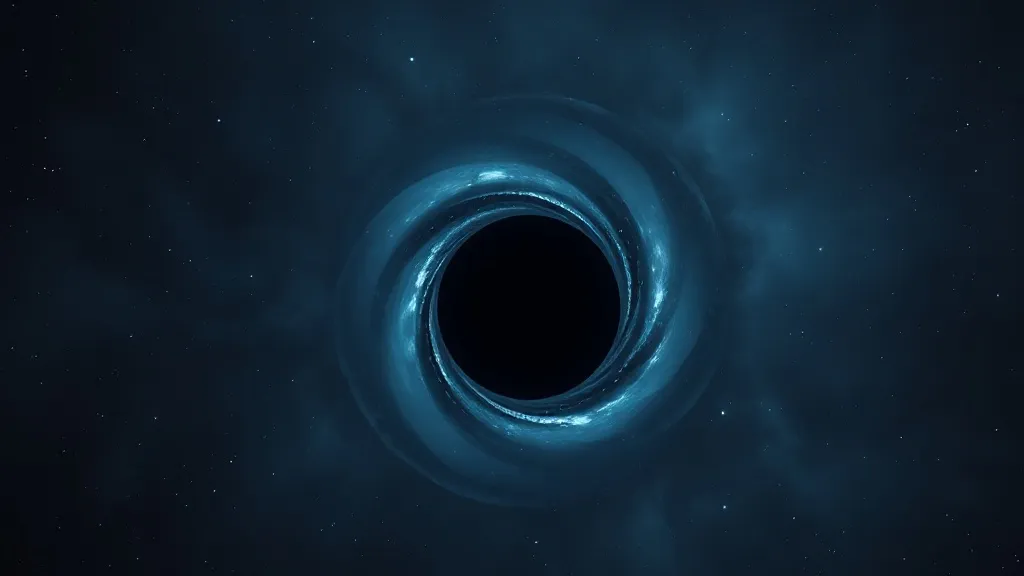
J0439+1634, a supermassive black hole active just 850 million years after the Big Bang, flickers like a candle flame - and its surprisingly flat, organized accretion disk is challenging what we thought we knew about early black hole growth.
MIT astronomers have detected the earliest known flickering quasar - a supermassive black hole blazing with activity just 850 million years after the Big Bang - and found that its accretion structure looks far more settled and mature than current models of early black hole growth predict.
The quasar, designated J0439+1634, was studied by Gene Leung, a postdoc at MIT’s Kavli Institute for Astrophysics and Space Research, and Anna-Christina Eilers, an assistant professor of physics at MIT. Their findings were published in Nature Astronomy.
The first flickering quasar seen at cosmic dawn
Quasars are among the most luminous objects in the universe: supermassive black holes consuming surrounding gas and releasing enormous amounts of energy in the process. J0439+1634 shines with the brilliance of approximately 12 trillion suns, powered by a black hole exceeding 600 million times the mass of our own Sun.
What sets this particular quasar apart is its behavior over time. “Although there have been a lot of quasars found in the cosmic dawn, this is the first time we actually see one flickering,” Leung said. The quasar’s brightness varies by roughly 20 percent - the equivalent of about 2 trillion suns - and does so randomly, without a fixed pattern.
The team detected this variability by reprocessing 14 years of archival data from NASA’s NEOWISE mission, a space-based infrared telescope that repeatedly scanned the sky from 2010 to 2024. Stitching together observations across that long baseline was necessary to detect slow brightness changes in an object whose light has traveled more than 13 billion years to reach Earth. The work of reprocessing the NEOWISE data was led by Kishalay De, a former MIT postdoc now at Columbia University.
An unexpectedly mature structure
More significant than the flickering itself is what the variability pattern reveals about the quasar’s structure. According to the researchers, it is consistent with a flat, thin, pancake-shaped accretion disk - the ring of gas spiraling into the black hole - of a kind typically associated with well-settled, mature systems.
This was not what models of early-universe black holes predict. Standard frameworks anticipate that supermassive black holes at cosmic dawn should still be deep in a chaotic growth phase, with thick, disordered accretion structures inflated by the intensity of early feeding. J0439+1634’s organized disk suggests it had already reached a settled, steady state at a point barely 6 percent of the current age of the universe.
Eilers offered a possible interpretation: the most violent, rapid early growth phases for black holes like J0439+1634 “happen very, very early on, before we see them as these very bright luminous quasars.” In other words, by the time this black hole is luminous enough to be detected as a quasar, the chaotic phase may already be complete.
What remains unresolved
Exactly how supermassive black holes of this mass assembled so quickly, and why this one in particular shows an organized disk structure at such an early epoch, remains an open question. Whether J0439+1634 is typical of its class, or an outlier that happened to be caught in an unusual state, requires further study with additional early-universe quasars.
Leung noted that the observed flickering originates from “fluctuations in the way the gas is being fed into the black hole” - a physical process that can now, for the first time, be studied at cosmic dawn rather than only in nearby, well-documented quasars. That access to the feeding dynamics of an early black hole is itself scientifically significant, independent of what the structure implies.
Eilers placed the discovery in a broader context: “Without supermassive black holes, no galaxy would look the way it does today.”
The method’s potential
The NEOWISE approach - detecting slow brightness variability in distant objects by combining years of repeated sky scans - opens a new observational window on the early universe. Future infrared surveys with longer archives and greater sensitivity could apply the same technique to push further back in cosmic time, potentially revealing how common organized accretion structures are in the first billion years after the Big Bang.
The study, “Discovery of quasar variability and early accretion disk signatures at cosmic dawn,” appears in Nature Astronomy (DOI: 10.1038/s41550-026-02897-4).