A hitchhiking teenager and two Exeter patrolmen reported a barn-sized shape with pulsing red lights, silent and low. Project Blue Book tried aircraft, refueling flights and 'stars and planets' - then logged the case as unidentified.
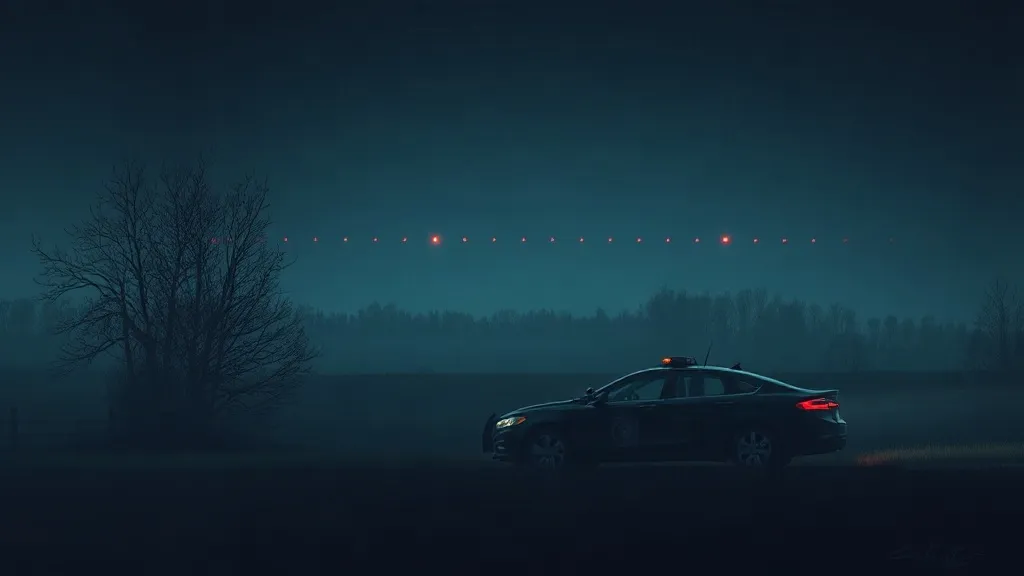
Just after 2 a.m. on September 3, 1965, an 18-year-old named Norman Muscarello was hitchhiking along an empty road near Exeter, New Hampshire, when the field beside him lit up. A dark shape rose from behind the trees, carrying a row of brilliant red lights that pulsed in sequence. It was, he later said, huge and completely silent. He dove into a ditch, then ran to a farmhouse and pounded on the door.
What Muscarello and two responding police officers reported that night became one of the most carefully documented UFO cases in American history - and one the U.S. Air Force’s own investigators, after floating several ordinary explanations, ultimately logged as “unidentified.”
The case still matters for a simple reason. The witnesses were not a lone dreamer but trained observers on duty, and the official file records their sighting without ever resolving it. Sixty years on, skeptics believe they have finally pinned down the mundane answer. The record rewards a close read.
A frightened driver, then two officers
Muscarello flagged down a passing car and got a ride to the Exeter police station, where he reported what he had seen. The account did not arrive out of nowhere. Earlier that same night, according to Wikipedia’s summary of the case files, Officer Eugene Bertrand had stopped to help a woman parked along a nearby highway who said a lit object had trailed her car for miles.
Bertrand drove Muscarello back to the field on Route 150. As the two walked toward a farmhouse, the object lifted from behind a stand of trees. Bertrand described a dark mass “as big as a barn” that swayed “back and forth” as it moved, ringed with pulsing red lights and making no sound. He called for backup, and Officer David Hunt arrived in time to watch it drift off toward the coast. By the account collected in New Hampshire Magazine, Muscarello said the lights dimmed in a distinctive order - “5-4-3-2-1, then 1-2-3-4-5.”
The Air Force tried three answers
Because the encounter happened near Pease Air Force Base, it was passed to Project Blue Book, the U.S. Air Force’s official UFO investigation. The first officer assigned to it, Major David Griffin, wrote that he had been “unable to arrive at a probable cause.”
Over the following weeks the explanations shifted. Blue Book’s chief, Major Hector Quintanilla, wrote to the Exeter police attributing the sighting to a high-altitude military exercise called “Operation Big Blast.” A separate Pentagon letter suggested the witnesses had seen aircraft on a refueling run, or perhaps “stars and planets” distorted by a temperature inversion - a layer of warm air that can bend light and make points in the sky shimmer and dance.
Bertrand and Hunt objected in writing. The object they watched was silent, low, and close, they argued, and the Big Blast aircraft had already left the area by the time they were standing in that field. Months later, according to the case record, Blue Book conceded it could not identify what the officers had seen. The file joined the office’s small pile of genuinely unexplained cases, alongside entries such as the 1964 Socorro landing in New Mexico, which a policeman also reported and which Blue Book never resolved.
The case skeptics say is closed
Journalist John G. Fuller turned the sighting into a national story. His 1966 book “Incident at Exeter” sold roughly half a million copies and helped carry UFO reporting into the mainstream.
Decades later, the skeptics answered. Writing in Skeptical Inquirer in 2011, investigator Joe Nickell and retired Air Force pilot James McGaha argued that the culprit was a KC-97 aerial-refueling tanker. Such planes fly slowly and low during operations, they noted, and a row of lights along the aircraft’s underside can appear to pulse and hang in the night sky, roughly matching the sequence the witnesses described. Refueling flights, they wrote, were active in the region that night.
It is a plausible reconstruction, and it may well be right. But it does not fully close the gap that has kept the case alive: the officers always insisted the object was silent and near at hand, not a distant, droning aircraft at altitude. That tension - a reasonable explanation on one side, credible witnesses who reject it on the other - is precisely the kind of case that motivated Blue Book’s astronomer to build a scale for ranking sightings rather than simply filing them away.
That is why the Exeter file is still worth studying. It has what most UFO reports lack: multiple credible witnesses, an official investigation, and a paper trail. And it still does not resolve cleanly. The lesson is not that something alien visited a New Hampshire field. It is that “unidentified” is an honest label for missing data - a case the evidence cannot yet settle in either direction. The town has embraced the story, marking its anniversaries with an annual Exeter UFO Festival that draws crowds each September. The mystery, fittingly, remains open.