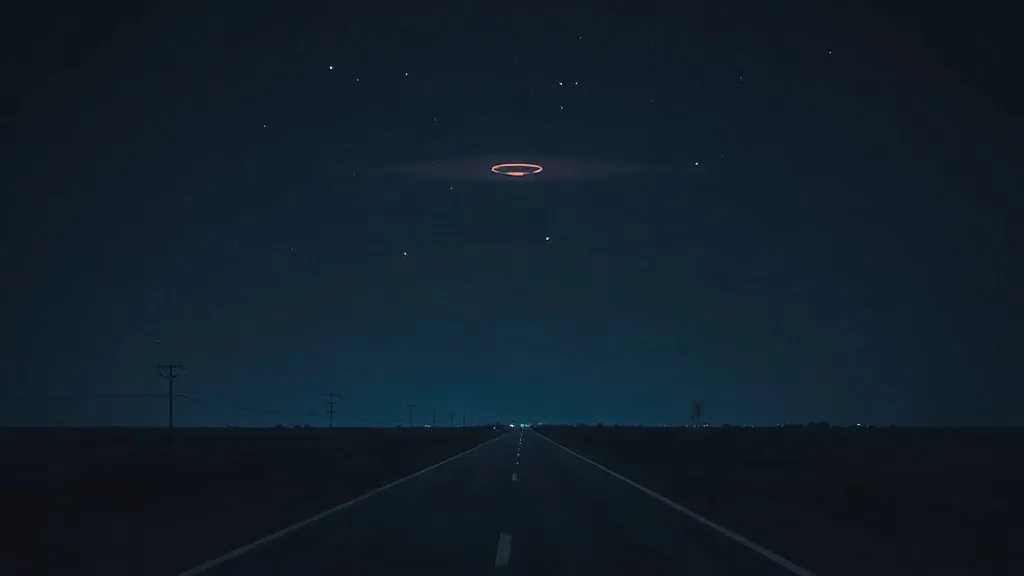
On January 8, 2008, dozens in Stephenville, Texas described a huge, silent craft. A later analysis of FAA radar records logged an unknown, transponder-less object - and the Air Force's account of that night changed twice.
For about an hour after sunset on January 8, 2008, people around the small dairy town of Stephenville, Texas kept looking up at the same thing: a formation of bright, silent lights, low and enormous, drifting over the farmland and then moving off at a speed no one could place. Dozens of residents reported it, including a local pilot and business owners not in the habit of calling the newspaper about the sky.
What has kept the Stephenville case in the file drawer of serious UFO research is not the eyewitness drama. It is a second, colder record. Months later, two independent analysts obtained the raw radar data from that night and found that something large, fast and carrying no identification signal really had been in that airspace. What the object was has never been established, and no evidence ties it to anything otherworldly. But the government’s own account of the evening did not stay still.
What people on the ground described
The witnesses did not agree on everything, but they agreed it was big and quiet. Steve Allen, a local pilot, told reporters the formation of lights spanned about a mile long and half a mile wide, made no sound, and covered ground fast - he estimated thousands of miles per hour, according to HISTORY. Another witness likened it to “the size of four football fields,” NPR reported, describing lights that formed an arch and then split into vertical lines.
Several witnesses said the lights were followed by fighter jets flying low. The comparisons in the local press were immediate: this looked, to many, like a rural echo of the 1997 Phoenix Lights mass sighting, another case where large numbers of ordinary people watched a silent formation for long minutes.
The radar record, and why it matters
UFO reports usually live or die on human memory, which is why the way analysts and instruments actually study these events matters more than any single testimony. Stephenville is unusual because it left an instrument trail.
Two investigators - Glen Schulze, who had radar experience from White Sands Missile Range, and Robert Powell, an engineer - filed Freedom of Information Act requests for the raw radar data and, in July 2008, released a 77-page analysis of Federal Aviation Administration and National Weather Service records from that night, according to Wikinews’ account of the report. Their central finding: the radar twice caught an object moving at roughly 2,000 miles per hour, carrying no transponder - the box that broadcasts an aircraft’s identity. The report noted that one tracked object was, at one point, heading toward Prairie Chapel Ranch, President George W. Bush’s residence near Crawford. The authors drew no conclusion from that detail.
None of this proves a craft, let alone an alien one. A radar return is an echo, and echoes can be produced by weather, birds, ground clutter or hardware that is hard to identify after the fact. The value of the report is narrower and more honest: it documented that a fast, silent, unidentified target was consistent in time and place with what people said they saw.
The story that changed
The most quoted part of Stephenville is not the lights. It is the Air Force.
In the days after the sighting, Air Force Reserve officials at the Fort Worth base first said they had no aircraft in the area and suggested residents might have seen an optical illusion, as NPR reported. Weeks later they reversed course, acknowledging that ten F-16 fighters from the 457th Fighter Squadron had in fact been training in the area that night. “An error was made regarding the reported training activity,” a spokesman said.
For skeptics, those jets are the answer. A Skeptical Inquirer analysis of the case argued for prosaic explanations rooted in aircraft and their lights rather than exotic technology. It is a serious position: F-16s dropping flares can look startling and unfamiliar at night. But witnesses and the radar analysts made a distinction that still frames the case - they were not claiming the object was the F-16s; they were asking what the jets appeared to be responding to.
That is where Stephenville rests. Like most cases the Pentagon now logs, it is “unresolved,” which - as AARO investigators are careful to note - means missing data, not proof of the extraordinary. Eighteen years on, no document has closed it, and no document has confirmed anything more than this: on one January night in Texas, a lot of level-headed people, and a radar set, recorded something that has never been fully explained.