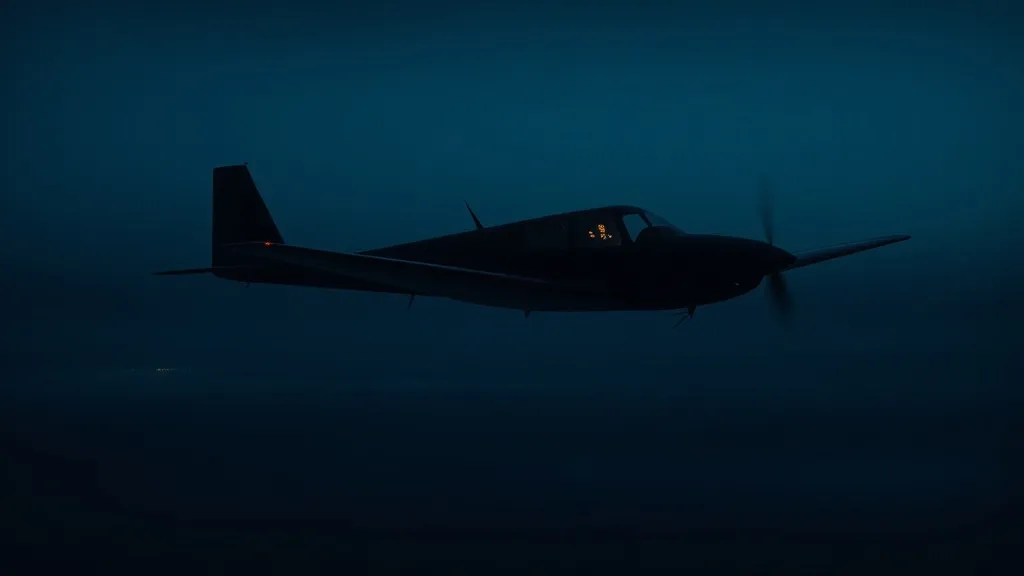
Frederick Valentich, 20, was flying a rented Cessna to King Island when he told air traffic control a metallic craft was circling above him. His last transmission ended in 17 seconds of scraping static. Australia's official inquiry never determined what happened.
On the evening of 21 October 1978, a 20-year-old pilot named Frederick Valentich took off from Moorabbin Airport, south of Melbourne, in a rented single-engine Cessna 182. He was flying south across Bass Strait - the stretch of open water between mainland Australia and Tasmania - on a routine night flight to King Island. He never arrived. In his last minutes of radio contact, Valentich told air traffic control that a metallic craft was circling above his plane. Then his microphone recorded 17 seconds of scraping static, and he was gone.
Nearly half a century later, no confirmed trace of Valentich or his aircraft has ever been found, and Australia’s official investigation was unable to determine what happened. That open finding is exactly why the case has never gone away.
Six minutes of radio, then silence
Around 7:06 pm, Valentich radioed Melbourne Flight Service and the officer on duty, Steve Robey. He asked whether any known traffic was in his area below 5,000 feet. Robey told him there was none. Valentich then reported a large aircraft with four bright lights passing roughly 1,000 feet above him.
Over the next few minutes his descriptions grew stranger and more urgent, according to the released transcript. He said the object was orbiting above him, that it had a shiny metallic surface and a green light, and, in the line most often quoted, “it is not an aircraft.” Moments later he reported that his engine was rough idling and coughing. His final words were cut off. What the recording captured next was described in the official file as an unidentified metallic, scraping sound lasting about 17 seconds, then nothing.
A four-day air and sea search covering thousands of square kilometres found no wreckage and no body. It was called off on 25 October.
What the evidence does and doesn’t show
Part of what keeps the Valentich case alive is that it is unusually well documented for a UFO report. There is a named, apparently level-headed witness in live radio contact with the ground, a time-stamped transcript, and a formal government inquiry. The Australian Department of Transport returned an open finding: the reason for the disappearance was not determined, and Valentich was presumed to have died.
An open finding is not an endorsement of an extraterrestrial explanation. Investigators had earthly candidates too. Writing in Skeptical Inquirer, astronomer and pilot James McGaha and investigator Joe Nickell argued that the four lights Valentich described match a real arrangement in the sky that night: the planet Venus, then at its brightest, together with Mars, Mercury and the star Antares, clustered in a pattern the eye tends to connect into a single shape.
Their reconstruction goes further. A pilot with only 150 flying hours, at night over dark water with almost no visual references, is a textbook setup for spatial disorientation - a state in which the inner ear and the eyes disagree and a pilot can lose track of which way is up. McGaha and Nickell suggest Valentich may have entered a slow “graveyard spiral,” an unrecognised descending turn. That, they argue, could explain both his report of an object “orbiting” him and the engine trouble, as a gravity-fed fuel system faltered during the manoeuvre. The pair also noted that Valentich had failed commercial-pilot exams and had a known interest in UFOs.
Why an open case still matters
None of the mundane explanations has been proven either. No conclusive wreckage has been recovered. In 1983 an engine cowl part from a Cessna washed ashore in the region, and its identification numbers fell within a range that could have included Valentich’s aircraft, but investigators could not confirm it came from VH-DSJ.
The Valentich case endures because it sits precisely where credible UFO investigation lives: a real, unresolved event with competing, testable explanations and too little physical evidence to close it. It is a reminder of how much a case can hinge on data that no longer exists. Modern investigators hit the same wall - the Pentagon’s UAP office has repeatedly said its largest obstacle is a shortage of usable sensor data, the problem at the heart of how scientists actually study these cases.
It is also a report built almost entirely on one pilot’s voice, with nothing on radar to corroborate it - a limitation that recurs whenever an unidentified object leaves no instrument trace. Later aviation encounters would be different: eight years afterward, a Japan Air Lines crew’s UFO report over Alaska came with radar returns and an FAA file. Valentich left only six minutes of tape, a missing plane, and a question Australia’s own investigators declined to answer.