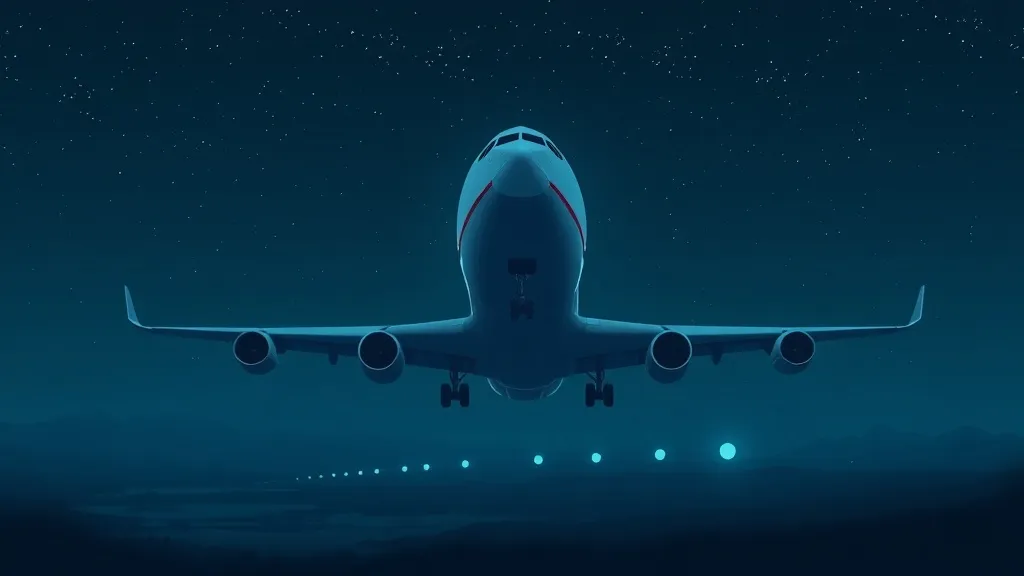
Captain Kenji Terauchi had nearly three decades in the cockpit when his Boeing 747 was reportedly followed by three unidentified objects for 50 minutes over Alaska. The FAA cleared his crew as credible - and could not identify what they saw.
At 5:11 p.m. on November 17, 1986, a Japan Airlines Boeing 747-200F cargo jet crossed into Alaskan airspace at 35,000 feet, carrying wine and other cargo on a routine Paris-to-Tokyo run. Three crew members were aboard. The flight had been unremarkable.
Then Captain Kenji Terauchi looked to his left.
What followed became one of the most thoroughly documented - and most persistently unresolved - aviation UAP cases in the historical record.
What the Crew Reported
Terauchi, a JAL captain with nearly three decades of flying experience, first noticed what he described as two smaller craft with unusually bright lights pacing the aircraft. He radioed Anchorage Air Route Traffic Control. According to the initial response, controllers saw radar returns consistent with his position.
The FAA advised evasive maneuvers. Terauchi descended and turned. The lights, he later said, stayed with the plane.
He then reported a third object. In interviews and diagrams submitted to investigators, Terauchi described it as massive - he estimated it as roughly twice the size of an aircraft carrier - and said it trailed the Boeing 747 for several hundred miles before eventually departing.
His first officer, Takanori Tamefuji, and flight engineer Yoshie Tsukuba reported seeing something unusual: lights that were “not town lights,” Tsukuba told investigators. But their accounts were more measured than Terauchi’s. Neither reported seeing distinct aircraft structures. The language barrier during the English-language debriefing also complicated the interviews, according to investigators.
The FAA Opens an Investigation
What distinguishes JAL 1628 from most reported UAP encounters is what happened on the ground: the FAA formally investigated it.
That was unusual. The FAA does not have a standing mandate to investigate unidentified aerial phenomena, and official investigations of UAP reports from civilian aviation were extremely rare in the 1980s. Yet investigators traveled to Anchorage, debriefed the crew, and examined the radar data.
Their conclusion about the crew was unambiguous. The three crew members were “normal, professional, rational” and showed “no drug or alcohol involvement,” the FAA determined. Whatever they believed they had seen, investigators found no reason to doubt they genuinely believed it.
John Callahan, who served as the FAA’s Division Chief of Accidents, Evaluations and Investigations, later stated that he analyzed the radar data at the FAA Technical Center in Atlantic City, synchronizing returns with audio from the cockpit-to-controller exchange. Callahan has claimed that a subsequent briefing with FAA, Air Force, and CIA officials resulted in the data being confiscated, and that he retained a personal copy. The FAA has not confirmed this account, and Callahan’s claims - first made publicly in 2001 - remain unverified by independent sources.
Four Radar Systems, No Clear Answer
The radar data was the case’s most technically contested element. Four separate radar systems were examined:
Two showed no returns near the aircraft. One showed brief, suspicious anomalies that investigators classified as inconclusive. One briefly acquired a target near Flight 1628’s position - but it disappeared before it could be confirmed as anything definitive.
The FAA’s final public conclusion, delivered at a press conference on March 5, 1987, attributed the radar contact to a “split image” of the aircraft itself - a known artifact that can appear when radar timing is slightly off. The agency’s Alaska public affairs officer stated that the FAA “does not have the resources or the Congressional mandate to investigate sightings of unidentified flying objects.”
Two other aircraft - a United Airlines jet and a U.S. Air Force C-130 - were directed toward the area to observe. Neither reported seeing anything unusual, visually or on their own instruments.
Skeptical Explanations
The most detailed skeptical analysis came from aviation journalist and UFO investigator Phillip J. Klass, who concluded that the two smaller objects were likely the planets Jupiter and Mars. Both were visible in the area that night, and Jupiter was approximately 10 degrees above the horizon - a position that Klass said could create an impression of proximity to the aircraft.
The larger “mothership” Terauchi described is harder to account for with that explanation. No single conventional explanation has fully addressed the captain’s description of its scale and duration. Notably, Terauchi’s account differed in significant ways from those of the other two crew members, who described lights rather than structured craft.
What Happened to the Captain
Captain Terauchi was grounded by Japan Airlines after he spoke publicly and the case attracted international media coverage. Sources vary on the duration, with estimates ranging from several months to over a year of desk duty. He was later reinstated and returned to flying.
An Open File
JAL 1628 sits in an uncomfortable position in the UAP record. The skeptical explanation - misidentified planets - is plausible for part of what Terauchi described. The inconsistencies between crew accounts, the absence of visual corroboration from two other aircraft, and the radar evidence that reduced to “inconclusive” all weigh against the more dramatic interpretation.
But the FAA’s own assessment - that an experienced, credible crew reported something that genuinely concerned them, over an extended period, with partial and contradictory radar data that could not be definitively explained - has never been withdrawn. Whatever JAL 1628 encountered over Alaska nearly 40 years ago, the investigation that followed produced no satisfying answer.
The file has been public for decades. It remains open.