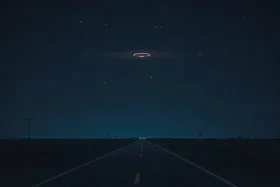
Since 1984, researchers from a Norwegian university have trained cameras, radar and spectrometers on the recurring lights over Hessdalen valley - a rare case of a UFO studied like a science problem. The data is real. A single confirmed cause is not.
On winter nights in a quiet valley in central Norway, lights appear that no one has been able to fully explain. They hang above the ridgelines, sometimes almost still for close to an hour, sometimes darting away. And for more than 40 years, scientists have been standing in the snow trying to catch them on instruments.
The Hessdalen lights are recurring, unexplained glowing objects seen over the Hessdalen valley, south of Trondheim. Since the 1980s, researchers - led today by Norway’s Ostfold University College - have studied them with cameras, radar, magnetometers and spectrometers. That makes Hessdalen one of the very few “UFO” phenomena ever measured with scientific instruments rather than only described by witnesses. The measurements are real. A single, confirmed explanation still is not.
The valley that started watching back
In the early 1980s, residents of Hessdalen began reporting lights far more often than usual. According to the project’s own record, the phenomenon peaked between December 1981 and the middle of 1984, when the lights were being seen 15 to 20 times a week.
That frequency is what made Hessdalen different. Most famous UFO reports are single events - a pilot, a night, a story that can never be checked again. Hessdalen kept happening, in the same place, which meant scientists could bring equipment and wait.
In 1984 a field campaign called Project Hessdalen set up cameras, radar, a seismograph, magnetometers and a spectrum analyzer - a device that splits light into its colors to reveal what a glowing object is made of. The lights were photographed repeatedly. Then the researchers did something unusual for the field: they left the instruments running. Since 1998, an Automatic Measurement Station in the valley has recorded events around the clock with video cameras and a magnetometer, so an appearance no longer depends on a person happening to look up.
What the instruments actually caught
Between 2000 and 2002, a joint Italian-Norwegian effort called the EMBLA missions brought in the astrophysicist Massimo Teodorani and colleagues from the Italian National Research Council, adding optical spectrometers and radio receivers.
The spectra they recorded looked like a hot, glowing gas - a plasma, meaning gas so energized that its atoms have shed electrons and give off light. Teodorani’s team estimated that some of the lights radiated with a power of up to around 19 kilowatts, roughly the draw of a small bank of household space heaters, and reported that the brightness could swing wildly from moment to moment.
That is why this case matters. It is one thing to say people saw a light. It is another to have a spectrum, a power estimate and years of continuous recordings. This is close to how the science-first approach now favored for military sightings says unidentified phenomena should be handled - measure first, then argue. It is the same logic behind how scientists actually study unidentified phenomena: trade the anecdote for a sensor reading.
Plenty of theories, no verdict
Here is the honest catch. After four decades of data, there is still no agreed explanation.
Researchers have floated several natural mechanisms. One leading idea is a “dusty plasma” - dust in the air becoming electrically charged, possibly ionized by radioactive radon gas seeping from the ground. Another points to the incomplete combustion of airborne mineral dust, since spectra have shown elements such as hydrogen, oxygen and titanium. A third invokes piezoelectricity, the small electric charge that quartz-bearing rock can produce when it is strained. Some have even proposed that the valley works like a giant natural battery, with different rock on each side and the river acting as the fluid between them.
What unites all of these is that they are ordinary physics. None of the scientists working at Hessdalen has claimed the lights are craft, and the instruments have turned up nothing that requires anything beyond geology, chemistry and the atmosphere. The mystery is genuine; the framing is not tabloid.
That distinction is the whole point of the guide to what actually counts as a glowing orb and to the Pentagon’s five observables - the specific behaviors that separate a real anomaly from a plane, a planet or a lens flare. Hessdalen clears the first bar most sightings never reach: it can be photographed again tomorrow.
Which is also why it endures as a kind of open-air laboratory. The lights are quieter now - by 2010 the count had fallen to something like 10 to 20 a year - but the station keeps watching. Somewhere in central Norway, the sky still lights up on occasion, a magnetometer twitches, a camera rolls, and a decades-old question stays open, on the record and unresolved.