Stefan Michalak said he touched a landed craft near Falcon Lake and took a blast of hot gas to the chest. He came home with burns, radioactive soil and an RCMP file - and a Mayo Clinic doctor who wasn't convinced. Nearly 60 years on, the evidence still won't fully resolve.
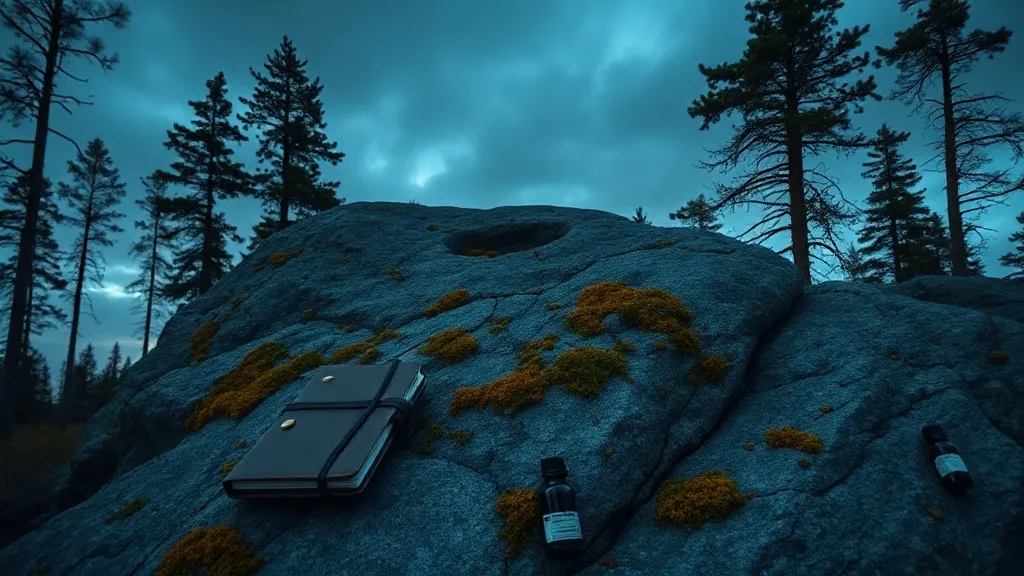
Just after noon on May 20, 1967, Stefan Michalak was on his knees chipping at a quartz vein in the granite of Whiteshell Provincial Park, east of Winnipeg, when two glowing objects dropped out of the Manitoba sky. One kept climbing. The other, he said, settled onto a flat slab of rock a stone’s throw away.
What the 50-year-old mechanic did next left a mark that investigators are still arguing about. According to his account, preserved in Royal Canadian Mounted Police and Royal Canadian Air Force files, he walked up to the landed craft, felt heat through his gloves, and then took a blast of hot gas to the chest that set his shirt alight and seared a strange pattern into his skin. The Falcon Lake incident is often called Canada’s best-documented UFO case - not because it proves anything landed, but because so much of it was written down, tested in a lab and filed away by the government.
That paper trail is why the case still matters. Most UFO reports leave nothing behind but a witness. This one left burns treated at a hospital, soil that a laboratory logged as radioactive, a scorched shirt now held in a public archive, and a stack of official reports - along with a skeptical medical opinion that has shadowed the story ever since.
A door, a hiss, and a grid of holes
Michalak described the object as roughly 35 feet across and metallic, glowing red as if cooling from its arrival. He said a door opened on its side, spilling bright violet light and a hiss of air, with sounds behind it he took for human voices. He called out in English, then in several other languages he spoke. Nothing answered.
When he approached and touched the hull, he said, the fingertips of his glove melted. Then the craft rotated, and he was hit by a rush of hot gas from a section of the surface that looked, to him, like a grid of evenly spaced exhaust holes. His shirt caught fire. He tore it off. Across his stomach was a pattern of burns that would become the single most contested detail of the entire affair.
What the lab actually found
Michalak made his way back to the highway, nauseated and reeking of what he described as burnt electrical wiring, and was treated that night at a Winnipeg hospital for first-degree burns. Over the following weeks the case drew in an unusual roster of investigators: the RCMP, the RCAF, Canada’s departments of health and national defence, the U.S. Air Force-funded Condon Committee at the University of Colorado, and civilian research groups.
Some of the physical evidence held up under scrutiny. Soil samples from the site were logged as radioactive enough that one report flagged them as a potential hazard, and a small piece of metal Michalak recovered was found to be roughly 95 percent silver. Investigators photographed a semicircle on the rock where moss had been stripped away.
Other pieces pointed the other way. The radioactivity was confined to a narrow crevice and, chemists suggested, was consistent with commercially available radium-based luminous paint - the kind once brushed onto glow-in-the-dark dials - rather than anything exotic. On November 6, 1967, Defence Minister Léo Cadieux told Parliament that the government would not publicly release its report. An internal defence memo, later made public, conceded a striking bottom line: investigators could not find evidence to dispute Michalak’s story.
Why a 1967 burn case still gets cited
The measured way to read Falcon Lake is to separate what is documented from what is disputed - the same discipline modern researchers apply when they study a physical-trace case. Documented: a real man, real burns, real lab results, a real government file. Disputed: what caused any of it.
The skeptical case is not thin. Hotel staff said Michalak had been drinking the night before, and the highway constable who first met him thought he looked hungover. And roughly eight months after the incident, Michalak produced photographs of a neat grid of marks on his abdomen. A Mayo Clinic psychiatrist who examined him in August 1968 described those later lesions as “obviously factitial” - medical shorthand for self-inflicted - while noting no sign of mental illness. Defenders counter that the tidy 1968 grid looks nothing like the irregular, blotchy burns that hospital staff and photographs documented within days of May 1967.
That unresolved tension is exactly why the case endures. It belongs to a short list of encounters that produced something a lab could hold, alongside the 1980 Cash-Landrum case in Texas, where three witnesses reported burns and radiation-style illness after a close encounter. Falcon Lake also unfolded the same year the Canadian navy spent three days searching the water off Nova Scotia for another object no one could identify.
Today the burnt shirt and case documents are held at the University of Manitoba Archives, and the RCMP and defence files can be read at Library and Archives Canada. Nearly six decades on, that is the real legacy of Falcon Lake: not proof of a visitor, but a physical file thick enough that neither believers nor skeptics can quite close it.