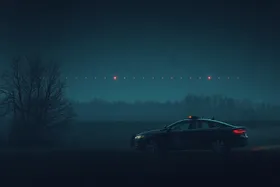
Two days after Christmas, Betty Cash, Vickie Landrum and her 7-year-old grandson watched a flame-spewing object hover over a road near Houston as military helicopters swarmed it. Within hours they were vomiting and blistering. They sued the U.S. government - and lost.
Two days after Christmas in 1980, a woman, her friend, and a 7-year-old boy were driving home through the pine woods northeast of Houston when the sky ahead of them lit up. Hovering above the treeline, by their account, was a diamond-shaped object as bright as a welding arc, spitting flame from its underside and throwing off so much heat that the car’s dashboard grew too hot to touch. Within hours, all three were vomiting. Within days, Betty Cash’s skin had blistered and her hair was falling out.
What happened on that road near Dayton, Texas has never been explained. But the Cash-Landrum incident - now filed among the historical unidentified anomalous phenomena reports researchers still argue over - became something almost no other UFO account ever has: a claim of physical injury that its witnesses carried all the way to federal court. They sued the United States government for $20 million, and a judge, after years of testimony, ruled that their injuries were genuine but that no agency could be shown to own the craft, or the helicopters that swarmed it.
A craft, and then the helicopters
Betty Cash, 51, was driving. Beside her sat Vickie Landrum, 57, and Vickie’s grandson Colby, 7. On an isolated stretch of Farm-to-Market road around 9 p.m. on 29 December 1980, they said, they came upon a large luminous object hanging low over the road. UFO investigator Jerome Clark, quoted in later accounts, described it as intensely bright and a dull metallic silver, its top and bottom flattened rather than pointed, ringed with small blue lights, and periodically shooting flame downward.
Frightened by the heat, Cash stepped out for a closer look while the others stayed at the car. When the object finally lifted away, the witnesses said, it did not leave alone. A fleet of helicopters appeared and moved off with it across the sky. They counted as many as 23, identifying some as twin-rotor CH-47 Chinooks - the heavy transport helicopter used by the U.S. military.
That detail is the hinge of the entire case. A glowing object is one thing; two dozen military helicopters escorting it is another, because it implies the government was present and knew exactly what was in the sky.
Real injuries, an unanswered question
In the following days, all three reported the same cluster of symptoms: nausea, diarrhoea, weakness, burning eyes, and skin that felt sunburned. Cash was by far the worst affected. She was hospitalised in early January 1981 with blistering, peeling skin and hair loss, treated for a condition doctors struggled to categorise. A physician who examined the group reportedly likened the pattern to radiation exposure, though that interpretation would later be contested.
The witnesses were documented not by hobbyists but by John Schuessler, a NASA aerospace engineer who worked on the Space Shuttle program and spent years compiling the case file. In 1982 the U.S. Army’s Inspector General assigned Lt. Col. George Sarran to investigate - the only formal government inquiry the case ever received. Sarran concluded that the witnesses were credible and were not lying, but found no evidence tying the helicopters to any branch of the armed forces.
That finding set the terms of the lawsuit. Represented free of charge, Cash and the Landrums sued the federal government, arguing that a military craft had injured them. On 21 August 1986 a U.S. district judge dismissed the case. The reason was not that the injuries were fabricated. It was that the plaintiffs could not prove the government owned the object or the helicopters. A court cannot hold an agency liable for a craft that no agency will admit exists.
Why the case still divides people
Skeptics have pressed hard on the details. Writing in Skeptical Inquirer, Robert Sheaffer argued that investigators were never certain where the encounter even took place, and that because both women lived for many years afterward - Cash died in 1998, Landrum in 2007 - their symptoms could not have come from a fatal radiation dose, and so were likely caused by something else. Others have noted that the U.S. did not keep 23 Chinooks massed in one location for a covert night mission, and that some of the medical complaints may have predated the encounter.
None of that closes the file. The counter-argument, pressed by researchers such as Curt Collins, is that three ordinary people gained nothing and lost their health, that an Army officer judged them honest, and that no ordinary explanation has ever accounted for the object, the escort, and the injuries all at once.
Unlike modern encounters captured on military infrared and radar, such as the Nimitz “Tic Tac” episode, Cash-Landrum rests almost entirely on human testimony and medical records. It endures for the same reason the strongest cases do: a documented event with real consequences and no clean answer, the kind of report that shows how hard these encounters are to actually investigate. It was never proof of anything alien. It is a court record, a stack of medical files, and a question the government answered only by stating, under oath, that whatever those three people saw, it was not theirs.