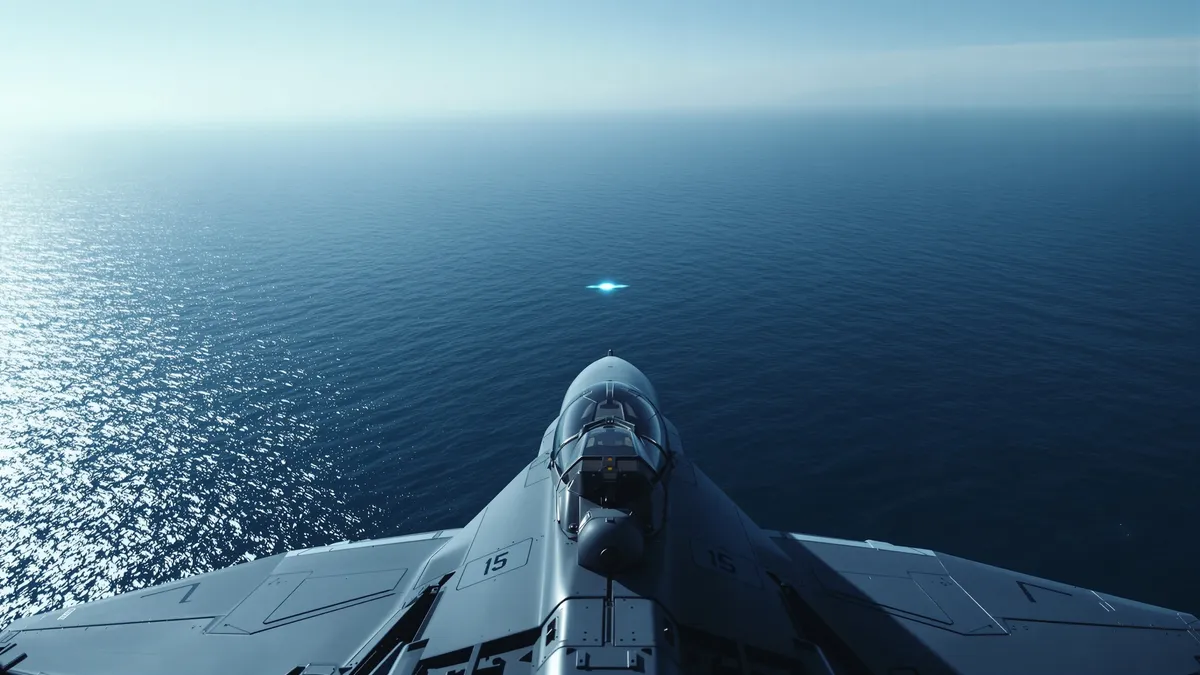
The 'Tic Tac' case remains the most documented UAP incident in U.S. military history. Here is a careful account of what pilots reported, what sensors recorded, and where the evidence stops.
Of the hundreds of UAP cases documented by the U.S. government, the November 2004 encounter involving pilots from the USS Nimitz carrier strike group stands apart. It is the case with the most corroborating sources - trained military aviators, shipborne radar operators, and an infrared camera - and the one whose official documentation has been most substantially verified. It is also a case in which, two decades later, the most fundamental question remains without a definitive answer.
The Setting
On November 14, 2004, the Nimitz carrier strike group was operating approximately 100 miles southwest of San Diego, California, conducting training exercises in the Pacific Ocean. The USS Princeton, a guided-missile cruiser accompanying the strike group, carried the AN/SPY-1 radar - among the most capable shipborne radar systems in the U.S. Navy.
For several days before the incident, Princeton’s radar operators had been tracking what they described as multiple anomalous aerial vehicles: contacts at high altitude that would descend rapidly and then hover or loiter. According to accounts from Senior Chief Kevin Day, the Princeton’s operations specialist, the objects showed no transponder signal, no infrared exhaust signature, and appeared to descend from above 80,000 feet in under a second.
The Pilots and What They Observed
Commander David Fravor, a Top Gun graduate and commanding officer of the “Black Aces” F/A-18F squadron, was assigned to investigate on November 14. He flew with Lieutenant Commander Alex Dietrich; each aircraft carried a weapons system officer. The four aircrew members are the primary eyewitness sources for what followed.
Fravor later described descending toward the area the Princeton had designated and observing “a white water disturbance” on the ocean surface - circular, roughly 60 feet across - as if something just below the surface was causing agitation. Approximately 50 feet above that disturbance hovered an object he described as white, featureless, approximately 40 feet in length, and shaped like a capsule or a Tic Tac breath mint. It had no visible wings, no exhaust, no markings.
When Fravor manoeuvred his aircraft toward it, the object mirrored his movements. When he attempted to close on it directly, the object accelerated - according to his account, nearly instantly - and disappeared. Minutes later, the Princeton’s radar picked up a contact approximately 60 miles away at a location that had been designated as a rendezvous point for the strike group - a location that, Fravor noted, the object could not have known.
Dietrich’s account, given publicly in congressional testimony and media interviews, corroborated the broad shape of Fravor’s observations. Both described an object that appeared to demonstrate awareness of their presence.
The FLIR Video
A second sortie dispatched after Fravor’s encounter carried an Advanced Targeting Forward-Looking Infrared (ATFLIR) pod operated by Lieutenant Commander Chad Underwood. Underwood captured what became known as the FLIR1 video - the footage most closely associated with the Nimitz case. The infrared recording shows an oblong object moving across the frame, at one point appearing to accelerate abruptly and exit the frame. It was Underwood who coined the “Tic Tac” description based on the object’s appearance in the thermal imagery.
The video was leaked publicly in 2007. A Pentagon spokesperson confirmed its authenticity in September 2019, and on April 27, 2020, the Department of Defense formally released the FLIR1 footage along with two videos from separate 2015 incidents. The DoD’s official statement said the videos depicted “unidentified aerial phenomena” - the department’s first public use of that term - and that the decision to release them was intended to “clear up any misconceptions by the public on whether or not the footage that has been circulating was real.”
What Has Been Officially Confirmed
Several facts are on the public record and not disputed. The USS Princeton’s radar operators tracked anomalous contacts over multiple days. Commander Fravor and the other three aircrew members observed an unusual aerial object on November 14, 2004. Lieutenant Commander Underwood recorded infrared footage of an object on the same day. The Pentagon confirmed in 2020 that the FLIR1 video is authentic and depicts a UAP. The Navy announced in 2019 that it had established new reporting guidelines for “unidentified aircraft” encounters, in part citing an increase in such reports.
Fravor testified before the House Armed Services Committee in 2023, stating the object demonstrated “capabilities well beyond the material science” available at that time or foreseeable in the near term. That testimony is in the public record; it represents his assessment, not a government finding.
What Remains Disputed or Unresolved
No official investigation has publicly identified what the object was. A 2021 U.S. intelligence assessment found “no evidence that aerial phenomena witnessed by Navy pilots were alien spacecraft” while offering no definitive alternative explanation.
Proposed conventional explanations have included advanced reconnaissance drones - Chinese or otherwise - and atmospheric optical effects. Neither has been confirmed. The ocean disturbance reported by Fravor is not captured on any known sensor record. Some researchers have questioned whether the reported speed and manoeuvre characteristics in Fravor’s account are consistent with what the FLIR footage itself shows, given the difficulty of judging angular velocity from a single moving platform.
AARO’s FY 2024 consolidated annual report does not include a resolved determination for the Nimitz case, consistent with the office’s description of it as the kind of multi-sensor historical case it was established to investigate.
Why the Case Endures
The Nimitz encounter is not the most dramatic UAP report in the historical record. What distinguishes it is the quality of the witnesses - career military aviators with advanced training in aircraft identification - and the existence of corroborating sensor data that has been officially authenticated. Most UAP cases rest on eyewitness testimony alone, or on imagery that cannot be verified.
That combination - trained observers, independent radar contacts, authenticated infrared footage, official acknowledgment - makes the Nimitz case the baseline against which other UAP claims are often measured. It does not resolve the question of what the object was. But it establishes, rigorously, that something was observed, and that what was observed has not been explained.