Four seasoned Army Reservists watched a gray, cigar-shaped craft halt over their helicopter near Mansfield, Ohio, and wash the cockpit in green light. Investigators still cannot fully explain what happened next.
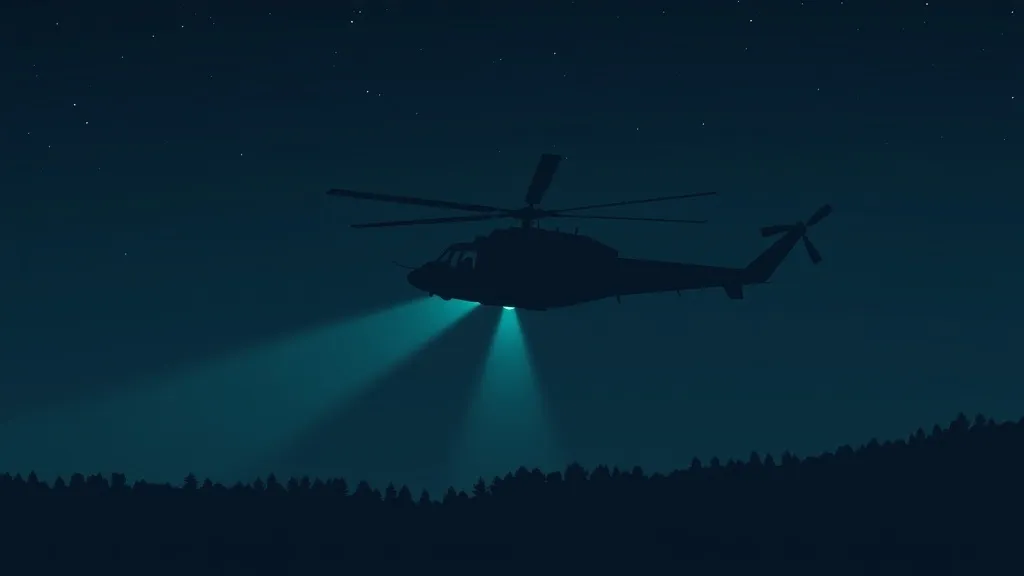
Just after 11 p.m. on October 18, 1973, an Army Reserve helicopter was cruising north toward Cleveland when the crew saw a single red light on the horizon swing toward them and close fast. Captain Lawrence Coyne, a pilot with 19 years of experience, pushed the aircraft into a dive to avoid a collision. Seconds later, according to all four men aboard, a gray, cigar-shaped object stopped directly over their Bell UH-1H “Huey” and washed the cockpit in green light.
What happened next is the part investigators still cannot cleanly explain. When Coyne looked back at his instruments, the helicopter had climbed by more than a thousand feet - even though, he said, he was still holding the controls to go down.
That single, well-documented flight is why the Coyne incident, near Mansfield, Ohio, is often called one of the most credible UFO cases on record. No one has proven what the crew saw. But the witnesses were experienced, their accounts were consistent, and the encounter was written up in an official Army report.
Four minutes over Mansfield
The crew had left Port Columbus airport around 10:30 p.m. after a routine flight physical, according to Ohio Magazine’s account. Flying at about 2,500 feet and 90 knots, crew chief Robert Yanacsek spotted a red light pacing them, then turning to approach.
Coyne first put the Huey into a 500-foot-per-minute descent, then a much steeper dive, and radioed the Mansfield control tower. The tower answered once, the crew reported, and then the radio went silent.
The men described the object as a smooth, gray, cigar or dome shape, roughly 60 feet long, with a red light at the front and a white light at the tail. A green beam, they said, swung down and filled the cabin. Then the object accelerated away to the northwest.
Only afterward did the crew register the strangest detail: the altimeter read far higher than it should have. Coyne’s magnetic compass, according to the local reporting, spun uselessly during the event and had to be replaced by maintenance crews.
Why this case gets taken seriously
Most UFO reports come from a single witness with no way to check the story. This one had four trained observers and independent people on the ground.
Investigator Jennie Zeidman, working with the Center for UFO Studies, tracked down witnesses beneath the helicopter’s path - including a woman driving near Charles Mill Reservoir with four children, who described a bright light and a green glow in the sky at about the same time. Her second-by-second timeline, documented in the case files, concluded the object was in view for several minutes, not the flash of a moment.
The crew’s standing mattered too. Coyne was a career officer and a police officer; medic John Healey was a Cleveland policeman. In 1978, Coyne described the encounter to a United Nations panel on UFOs, telling delegates he was “convinced this object was real.” A National Enquirer panel, for what it is worth, gave the crew a $5,000 award for the year’s most credible report.
For a science-minded reader, the value here is not proof of anything exotic. It is a clean example of how a case earns the label “unexplained”: multiple sober witnesses, physical effects on the aircraft, and no ordinary answer that fits every detail. It is the same standard the Pentagon now applies when it sorts modern reports into resolved and unresolved piles, and the kind of layered evidence scientists look for when they take a sighting seriously.
The part that is genuinely disputed
A famous case is not the same as a solved one, and the Coyne incident has a serious natural-explanation candidate. The Orionid meteor shower is active in mid-to-late October, and skeptics have argued that a bright fireball, seen head-on, could account for a fast red light and a green flash.
Zeidman’s analysis pushed back on that. A meteor lasts seconds, not minutes; it does not decelerate, hover, or make a hard turn; and it does not leave a helicopter climbing against its own controls. Those points, documented in the CUFOS case study, are why the investigation rejected the simple meteor answer - though a meteor cannot be ruled out for every element of the report.
The honest bottom line is the one the best witnesses gave themselves. Something real crossed their path that night, close enough to brace for. What it was, more than 50 years later, remains an open question - much like the aircrew encounters, from Tehran in 1976 onward, that instruments have logged but never fully resolved.