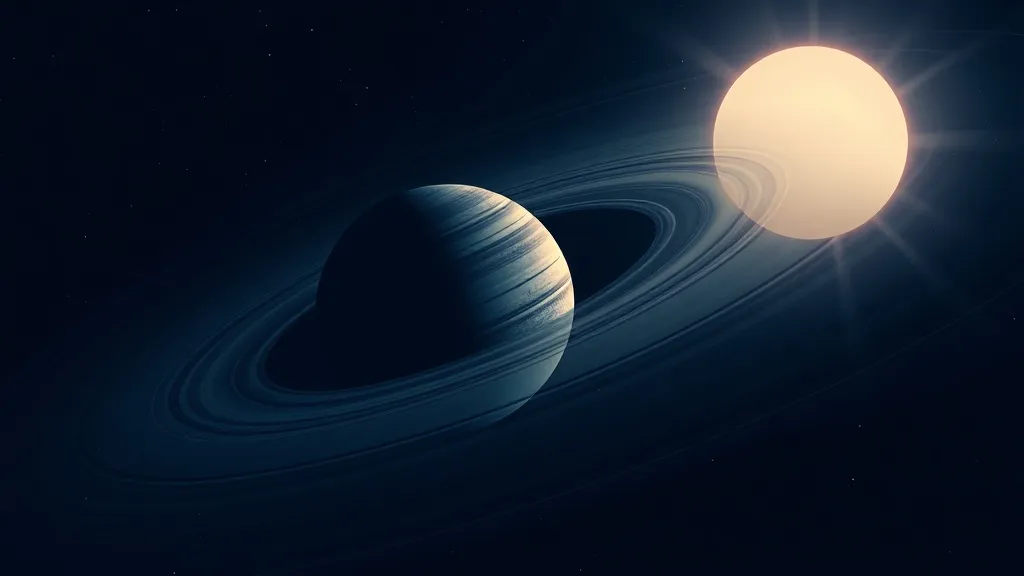
NASA's James Webb Space Telescope has recorded the sharpest view yet of HD 80606 b - a gas giant 217 light-years away whose temperature rockets by 1,100°F as it sweeps past its host star, revealing methane and carbon dioxide in its rapidly shifting atmosphere.
NASA’s James Webb Space Telescope has captured the most detailed look yet at an exoplanet undergoing extreme, rapid atmospheric change. Gas giant HD 80606 b, located 217 light-years from Earth in the constellation Ursa Major, sees its temperature spike by approximately 1,100 degrees Fahrenheit as it swings within close range of its host star - and Webb’s instruments have now recorded that transformation in real time, detecting shifting abundances of methane and carbon dioxide as the planet heats and then cools again.
The findings were presented June 16, 2026 at the 248th meeting of the American Astronomical Society in Pasadena, California, by a team led by Tiffany Kataria, a planetary scientist at NASA’s Jet Propulsion Laboratory. “Hot Jupiters are already considered some of the most extreme exoplanets we know of,” said Kataria, “but even among that population, HD 80606 b is one of the most extreme.”
An unusual orbit, an unusual laboratory
HD 80606 b is a gas giant roughly four times the mass of Jupiter. It orbits a Sun-like star on a highly eccentric, elongated path - far more stretched than any planetary orbit in our own solar system - completing one circuit every 111 days. For most of its orbit, the planet sits at a comfortable distance from its star. But at periastron, the orbit’s closest point, HD 80606 b plunges dramatically inward, receiving an intense burst of stellar radiation.
That geometry makes the planet an unusually efficient natural experiment. “Its unusual orbit allows us to gather data under varying conditions in just hours,” said co-investigator Laura Mayorga of Johns Hopkins Applied Physics Laboratory, noting that the same range of conditions on a more circular-orbit world would take years to observe.
The team used Webb’s MIRI - the Mid-Infrared Instrument - for an extended observation that spanned the planet’s approach to periastron, the flyby itself, and the aftermath. During the closest pass, HD 80606 b also transited behind its star from Webb’s perspective, an event called a secondary eclipse, allowing researchers to isolate the planet’s own infrared emission and subtract the star’s contribution.
Temperature spike and atmospheric chemistry
The temperature swing Webb recorded was steeper than previous estimates based on data from NASA’s now-retired Spitzer Space Telescope. “Webb has shown that the planet’s increase in temperature was even more extreme than we anticipated based on Spitzer data,” said Kataria.
Beyond the thermal measurement, Webb’s spectroscopic precision allowed the team to identify specific molecules shifting in HD 80606 b’s atmosphere as the heating event unfolded. Co-investigator Ryan Challener of Cornell University noted that “Webb enables us to distinguish specific chemical signatures like methane and carbon dioxide” - both of which are sensitive to temperature and shift in relative abundance as conditions change.
Methane, for instance, tends to break apart under intense heat. Carbon dioxide behaves differently, and observing both simultaneously under rapidly changing conditions gives researchers a live test of how atmospheric chemistry models perform under stress.
Preliminary results, significant implications
The research is presented at a conference stage rather than as a peer-reviewed paper; the team notes that further analysis is underway. What is confirmed, according to the authors, is that Webb’s MIRI captured real-time atmospheric dynamics on HD 80606 b with a precision that earlier missions could not achieve - not because those missions were inadequate, but because Webb’s sensitivity opens new windows on fast-moving events.
The broader significance extends beyond HD 80606 b itself. Understanding how a gas giant’s atmosphere responds to a rapid, intense dose of stellar radiation informs models of atmospheric retention, cloud formation, and chemical equilibria that apply to a wide range of planetary types - including the sub-Neptunes and super-Earths that are among the most common worlds in the galaxy.
HD 80606 b is not a candidate for habitability. But in its violent orbital arc, researchers now have a repeatable, real-time record of planetary atmosphere dynamics - one of the clearest such records Webb has yet produced.