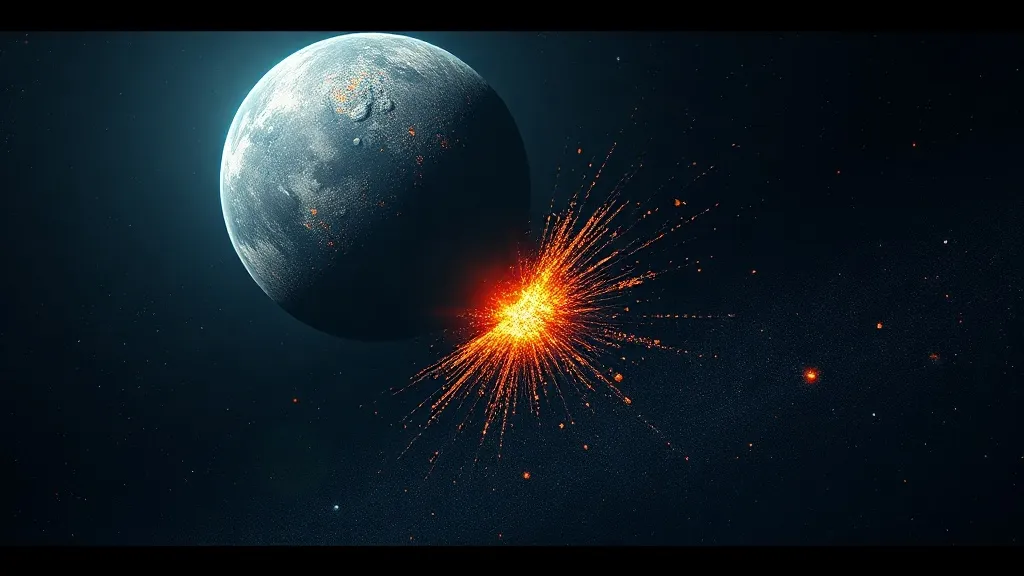
New impact simulations from ETH Zürich find that a single early-solar-system collision with a moon-sized body can simultaneously account for Venus' anomalous retrograde rotation and its absence of any natural satellite.
One of planetary science’s most persistent puzzles - why Venus rotates backwards and so slowly that a single day on the planet outlasts its entire year - now has a compelling unified explanation. Research presented at the European Geosciences Union General Assembly in Vienna this week finds that a single ancient collision with a moon-sized body, during the solar system’s first 50 million years, can simultaneously account for both Venus’ anomalous spin and for the fact that it has no natural satellite.
The study, published in Astronomy & Astrophysics by Bussmann, Gillmann and colleagues at ETH Zürich and the University of Bern, ran 81 three-dimensional impact simulations across a wide range of collision geometries and impactor sizes. The core finding: collisions involving bodies between 0.01 and 0.1 times Earth’s mass are capable of matching Venus’ observed rotation period while also producing post-impact debris too small and too close to the planet to coalesce into a stable moon.
“We are throwing a big rock at another very big rock, and we see how the planet deforms, and the consequences,” planetary scientist Cédric Gillmann of ETH Zürich, who presented the work at the EGU assembly, told Universe Today. The team applied smoothed particle hydrodynamics simulations - the same computational technique used to model the Moon-forming impact on early Earth - to trace how different collision parameters alter a planet’s rotation rate and determine how much debris escapes into orbit.
Venus is the solar system’s oddest spinner. Most planets rotate in the same direction as they orbit the Sun, but Venus rotates the opposite way - a retrograde spin. It does so at a glacial pace: one Venusian day equals roughly 243 Earth days, fractionally longer than the Venusian year of about 225 Earth days. The planet also has no moon, which sets it apart from Earth and from most other rocky bodies in the inner solar system.
Previous explanations invoked tidal forces from the Sun combined with atmospheric drag working over billions of years to gradually slow and reverse an initially more typical rotation. Those models can produce retrograde spin, but they struggle to also account for Venus’ moonless state - tidal braking is a slow process and does not in itself prevent debris from accumulating in orbit early in a planet’s history.
The new simulations offer a single-event solution to both problems. According to the paper, impacts that reproduce Venus’ rotation tend to deposit debris primarily inside the planet’s synchronous orbit radius, where tidal forces would rapidly pull material back toward the surface rather than allowing it to accumulate and form a satellite. The same collision that reversed and slowed the spin would therefore have precluded stable moon formation.
The simulations also found that different impact scenarios generate markedly different post-impact thermal states. In more energetic cases, the modelling indicates the collision may have melted the bulk of Venus’ mantle. Gillmann noted that such heat would ultimately dissipate, leaving few obvious surface signatures: “After a few hundred million years, you end up seeing an evolution that is very difficult to distinguish from a case where you don’t have an impact.”
That makes the hypothesis difficult to verify through surface geology alone. The team’s approach relies on the match between the simulations and Venus’ three observed constraints - retrograde rotation, slow spin rate, and the absence of a moon - as the primary line of evidence. No other current model accounts for all three simultaneously, according to the researchers.
The finding carries wider significance beyond the solar system. Venus is frequently studied as an analogue for rocky exoplanets that orbit at similar distances from their host stars. Stephen Kane of the University of California, Riverside, who focuses on Venus as an exoplanet comparison, has observed that a planet’s rotation rate has an “enormous effect” on cloud formation and, by extension, on long-term climate stability. If giant early impacts routinely set the initial spin conditions of rocky worlds, that has direct consequences for how astronomers assess habitability when cataloguing planets around other stars.
The researchers do not claim that tidal and atmospheric forces played no subsequent role in shaping Venus’ present rotation - such processes almost certainly contributed over geological time. But their work argues that the two most defining features of that rotation, its retrograde direction and its extreme slowness, along with the absence of a moon, can all be traced to a single violent event roughly 4.5 billion years ago.
Understanding what made Venus so different from Earth - despite both planets forming at comparable distances from the Sun from similar raw materials - remains one of the central questions in planetary science. This new work adds another line of evidence to the view that planetary histories can be redirected, decisively and permanently, by chance collisions in the early solar system.