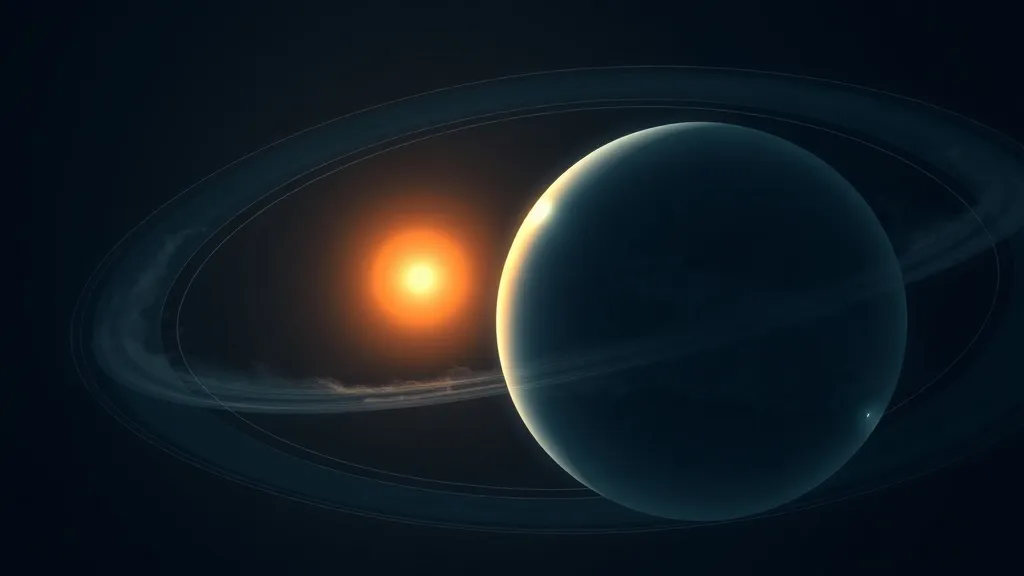
NASA's TESS mission has confirmed two Jupiter-sized planets orbiting a star 1,110 light-years away that are so diffuse they are lighter than cotton candy, setting a new density record for gas giants.
NASA’s TESS space telescope has confirmed two record-breaking exoplanets - TOI-791 b and TOI-791 c - that are so diffuse their densities fall well below that of cotton candy, making them the least-dense gas giants ever measured. A research team led by George Dransfield of the University of Oxford published the finding on June 24 in the Monthly Notices of the Royal Astronomical Society.
The two planets orbit a Sun-like star, TOI-791, approximately 1,110 light-years from Earth in the southern constellation Volans. Despite being comparable in size to Jupiter, they contain a tiny fraction of the solar system’s largest planet’s mass. TOI-791 b holds just 3 percent of Jupiter’s mass; TOI-791 c holds approximately 6 percent. According to Popular Science, that translates to densities of 0.022 and 0.027 ounces per cubic inch, respectively - compared to cotton candy at 0.29 ounces per cubic inch and Jupiter at 0.76. The planets are roughly 13 and 10 times less dense than cotton candy, and approximately 35 and 28 times less dense than Jupiter.
“These two planets have densities comparable to a nice blob of shaving foam, fresh from the can,” Dransfield said, according to CBS News. Fewer than 40 such “super-puff” planets have been identified among the roughly 6,300 confirmed exoplanets to date.
Super-puff exoplanets present a genuine challenge to standard models of how planets form. The current leading hypothesis, according to the research team, is that TOI-791 b and c formed far out in their protoplanetary disk, in cold regions rich in hydrogen and helium, accumulating enormous, low-density gas envelopes before migrating to their current orbits. Over time, super-puffs are expected to lose atmospheric material to space.
Jon Jenkins, science lead at NASA’s Ames Research Center, described the significance of the discovery in NASA’s news release. “The planets represent a puzzle for us to solve about how giant planets like Jupiter and the super-puffs form,” Jenkins said.
What makes this system particularly unusual is finding two super-puffs orbiting the same star. Most known super-puffs are isolated discoveries. Having a paired case study allows researchers to compare two low-density worlds that formed around the same star and have since evolved under each other’s gravitational influence.
A rare orbital dance
Adding to the system’s scientific value is a 5:3 mean-motion resonance: for every five orbits TOI-791 b completes around the star in its 139-day period, TOI-791 c completes three in its 232-day period. Resonant planetary systems tend to preserve orbital properties from the era of formation, making them useful records of early planetary dynamics.
Study co-author Tristan Guillot noted, according to Popular Science, that “these multi-planetary systems are complex, with gravitational interactions between the planets that evolve over very long periods, tens of years or more.” The resonance also allowed the team to calculate planetary masses using transit timing variations - measurable shifts in when each planet crosses its star - because the gravitational tug each planet exerts on the other leaves a detectable imprint on their timing.
How the planets were found
TESS detects planets by monitoring repeated, slight dips in a star’s brightness as an orbiting body passes in front of it. TOI-791 b was first flagged as a candidate by citizen scientists in the Planet Hunters project in 2019, and TOI-791 c was added as a candidate in 2023, both identified from TESS data. The research team then followed up with ground-based radial velocity measurements to refine the planetary parameters and confirm the system.
What comes next
NASA’s James Webb Space Telescope is expected to study the atmospheres of both planets through transmission spectroscopy, a technique that measures which wavelengths of starlight are absorbed as the planet transits - revealing the composition of the atmosphere layer by layer. Those observations may determine whether the planets are actively losing material to space and could test the hypothesis that super-puffs are inflated, transitional worlds on a slow path toward becoming smaller and denser.
Neither planet is considered a candidate for habitability. Their extended orbital periods mean they receive significantly less stellar energy than a planet in a typical habitable zone, and at 1,110 light-years, direct atmospheric characterization for biosignatures is not feasible with current instruments. The scientific value of TOI-791 b and c lies, for now, in what they can tell researchers about the outermost limits of planetary structure and the conditions under which planets form.