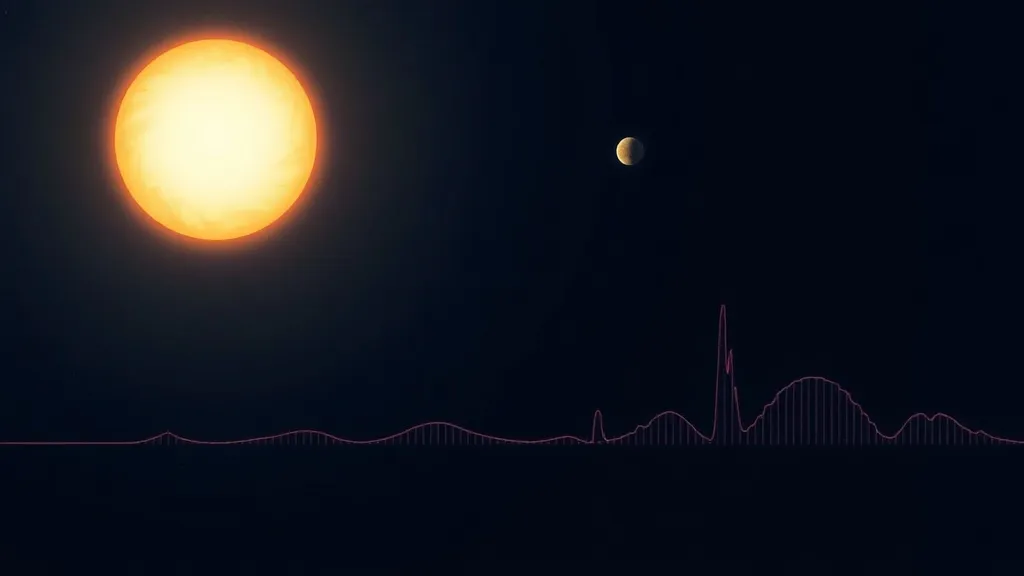
A lithium spike in the spectrum of a subgiant star 1,300 light-years away is consistent with planetary ingestion - and its close brown-dwarf companion may have pushed the planet inward.
A sun-like star designated TOI-5882, located approximately 1,300 light-years from Earth, carries chemical fingerprints consistent with having consumed one of its own planets. A study published 15 June 2026 in The Astrophysical Journal by a team led by University of Michigan graduate student Brooke Kotten presents spectroscopic evidence - unusually high lithium in the star’s atmosphere - that a planet once orbiting TOI-5882 fell inward and was incorporated into the star. The authors describe the case as a strong planetary engulfment candidate, not a confirmed detection.
What the lithium signal shows
Stars and planets both form from the same molecular cloud, but they retain lithium very differently. Stars burn through their lithium quickly during nuclear fusion; planets preserve it in far higher concentrations. When a star absorbs a planet, lithium from the consumed body is deposited into the stellar envelope, producing a measurable spike in surface abundance before it is eventually mixed into deeper, hotter layers where it too is destroyed.
Kotten and colleagues used the Tillinghast Reflector Echelle Spectrograph (TRES) to measure TOI-5882’s spectrum in detail, finding a lithium abundance of A(Li) = 2.49 plus or minus 0.12 dex - placing the star at the 98.4th percentile compared to a control sample of 61 similar subgiant stars drawn from the GALAH DR4 survey. According to the paper, alternative explanations - unusual initial composition, internal mixing processes, and binary mass transfer - were considered and found less consistent with the full set of observations.
The role of the brown dwarf companion
TOI-5882 is not a lone star. It hosts a companion designated TOI-5882 b, a brown dwarf with a mass of roughly 22 Jupiter masses orbiting in just 7.1 days. Brown dwarfs sit between giant planets and the lightest hydrogen-fusing stars: too massive to be a conventional planet, too light to sustain stellar nuclear reactions.
The researchers propose that the brown dwarf’s close, massive orbit gradually destabilized the trajectories of inner planets over time, eventually driving one onto a collision course with the host star. The engulfment event itself would have been rapid - spanning days to weeks on stellar timescales - making any direct observation impossible. The estimated mass of the consumed planet, reconstructed from the observed lithium excess, falls between roughly 9 and 95 Earth masses: the range from a super-Earth to a Neptune-class world.
Why planetary engulfment matters
Planetary engulfment has been predicted by orbital dynamics models for decades, but confirmed cases supported by direct chemical evidence remain uncommon. Stars like our own Sun are expected to consume their innermost planets as they expand into red giants, so developing a reliable methodology to identify these events in other stellar systems has broad scientific implications.
The paper contributes to what Universe Today describes as stellar archaeology - using chemical abundances as forensic tools to reconstruct past events that left no other observable trace. Identifying more engulfment candidates helps calibrate how frequently the process occurs, which conditions trigger it, and what the downstream consequences are for surviving planets in the same system.
What is documented and what remains uncertain
The core finding - that TOI-5882’s lithium abundance is anomalously high relative to similar stars at the same evolutionary stage - is robustly supported by the spectroscopic data and the comparative analysis of the control sample. The engulfment interpretation is the research team’s preferred explanation, but it is an inference: the consumed planet was not observed directly, and its mass, composition, and orbital history are all reconstructed from the lithium signal alone.
The study establishes a repeatable detection methodology. High-resolution spectroscopy, paired with a statistically significant comparison sample, can flag stars where planetary engulfment is a credible explanation for an elevated lithium measurement. That makes TOI-5882 a useful reference case as astronomers apply similar techniques to larger stellar catalogues in the years ahead.
The paper, “Lithium Enrichment in a Subgiant Star with a Brown Dwarf Companion: A Planetary Engulfment Candidate,” is published in The Astrophysical Journal and available as a preprint on arXiv.