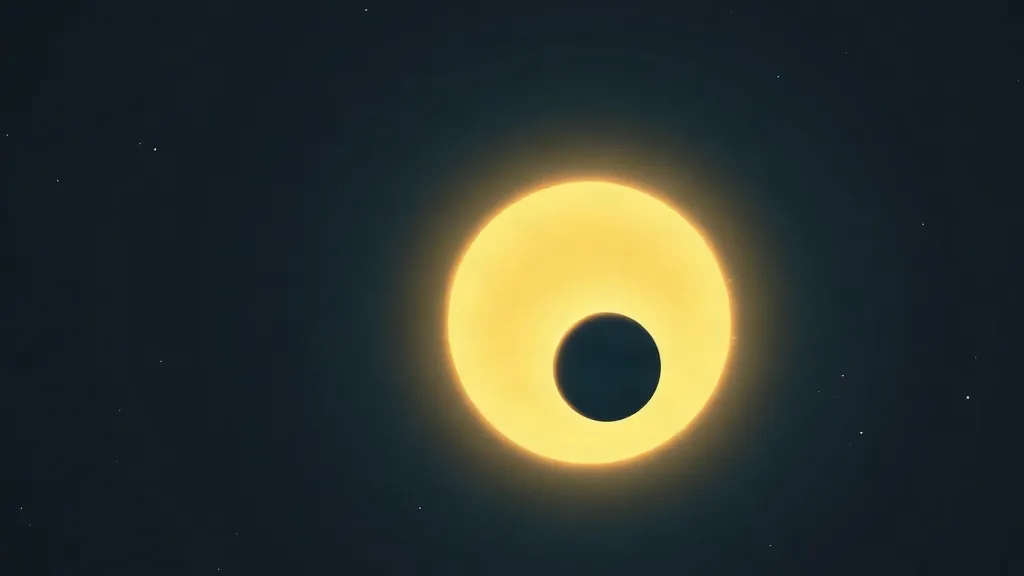
Tabby's Star spent a decade as the most famous 'alien megastructure' candidate in astronomy. A July 2026 study spotted a single symmetric transit in TESS data that fits a giant planet on a three-year orbit. It is suggestive, not confirmed.
For most of the last decade, one star in the constellation Cygnus held the strangest reputation in astronomy. Its brightness kept dropping in ways nothing familiar quite fit. For a while, respected researchers were willing to say out loud what the internet had already said louder: maybe someone built something around it.
The star is KIC 8462852, better known as Tabby’s Star after Tabetha Boyajian, whose team first flagged its bizarre light curve in 2015. It sits about 1,470 light-years from Earth. And in a paper posted to the preprint server arXiv in July 2026, a team led by Cristina Madurga-Favieres of the University of Warwick reports that a single, clean, symmetric dip in NASA’s Transiting Exoplanet Survey Satellite (TESS) data is consistent with a giant planet - roughly 9.4 times the mass of Jupiter - on a three-year orbit.
If it holds up, it is a boringly natural answer to a decade-long puzzle.
Why anyone said ‘aliens’ with a straight face
When a planet crosses in front of its star, the star dims a tiny amount, then brightens back up. The pattern is symmetric and it repeats. According to NASA, this is how the Kepler space telescope discovered thousands of exoplanets: it stared at one patch of sky and watched for those fingerprints in the starlight.
Tabby’s Star broke the pattern. Kepler saw sudden, deep, irregular dips - one as much as 22 percent, per the peer-reviewed record summarised on Wikipedia. Normal transiting planets cause dips of a fraction of one percent. The dips were jagged and one-off, not periodic. Layered on top, the whole star seemed to be slowly getting fainter over decades.
Nothing in the existing playbook cleanly explained all of that. So a group led by Penn State astronomer Jason Wright publicly asked whether an “artificial megastructure” - a swarm of solar collectors built by an advanced civilization to harvest a star’s energy - could produce that light curve. The idea traces back to physicist Freeman Dyson in 1960 and to the Kardashev scale, which ranks hypothetical civilizations by how much energy they command.
Wright and Boyajian were careful. They did not claim aliens. They said an alien megastructure was one hypothesis worth testing, and that natural explanations should be tried first. That is how astronomers handle any technosignature claim: propose it, then try to kill it.
How the natural explanations won ground
In 2017, the SETI Institute and other radio observatories pointed sensitive dishes at the star and heard nothing artificial. In 2019, a study using NASA’s Spitzer and Swift missions and the Belgian AstroLAB IRIS observatory reported to ScienceDaily that the long-term dimming was consistent with an uneven cloud of dust orbiting the star. Different wavelengths dimmed by different amounts, and dust behaves that way. Solid megastructures should not.
NASA itself, in a 2017 image feature, laid out the working picture: “an uneven ring of dust that makes long, semi-periodic dips in the star’s brightness.” The short, jagged dips likely came from clouds of comet-like fragments passing the star. The slow decade-long fading likely came from thicker rings of the same debris.
That is where mainstream astronomy has stood: probably dust, not a built object.
What the new paper actually claims
The July 2026 preprint, described by Phys.org and EarthSky, does not overturn any of that. It asks a different question: what is stirring the dust?
The Warwick and Institut d’astrophysique de Paris team went back through seven sectors of TESS observations and found one symmetric transit that, if real, matches a companion of about 9.4 Jupiter masses on a slightly eccentric orbit of roughly 2.35 astronomical units. Follow-up radial velocity measurements are consistent with an object in that mass range. A large planet on that kind of path could gravitationally shepherd comets and dust from the outer system past the star, in exactly the messy way Kepler recorded.
The team is upfront about the limit. The detection carries about 2.3-sigma significance, below the 3-sigma bar planetary science normally uses to call a signal confirmed, and rests on a single transit. The next chance to catch the same object crossing the star should fall between October 18 and 23, 2026. If a second transit shows up, the case gets much stronger. If not, the argument stays a hint.
Why this matters for how we hunt for aliens
The Tabby’s Star arc is a compact case study in how astronomy handles a technosignature candidate. A star did something strange. A serious group asked, on the record, whether aliens could explain it. Radio searches found no signal. Multi-wavelength observations gradually favored dust. A new dataset now offers a mundane physical driver that could tie the picture together.
None of that proves nothing built anything around KIC 8462852. It is much closer to no evidence for that hypothesis, and a growing pile of ordinary explanations. That is how the science works, and why the field takes years, not headlines, to close a case. The same discipline applies to any candidate signal, from a stray radio beep like the 1977 Wow Signal to a modern SETI scan of an interstellar visitor.
If the October window catches the planet again, the “alien megastructure” star ends up remembered as a dusty system with a lurking gas giant. That is less exciting than the sentence people started with, and more honest.