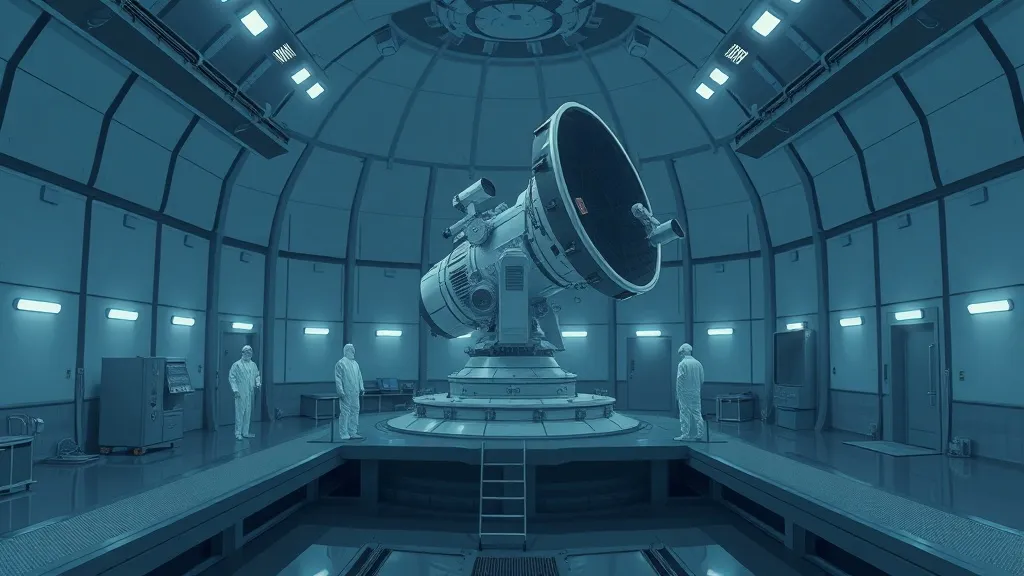
The nearly 18,000-pound observatory completed its barge journey from Maryland to Florida on June 21, beginning weeks of fuelling, solar panel tests, and clean-room checks before its August 30 target launch.
NASA’s Nancy Grace Roman Space Telescope arrived at Kennedy Space Center in Florida on June 21, 2026, completing its transit from Maryland and entering the final phase of prelaunch processing. The nearly 18,000-pound (8,200-kilogram) observatory is now housed in the Payload Hazardous Servicing Facility, where technicians will complete fuelling, solar panel testing, and thermal inspection before liftoff.
From Goddard to Florida
After completing integration and testing at NASA’s Goddard Space Flight Center in Greenbelt, Maryland, the telescope was secured in a protective, environmentally controlled transport container and driven to the port of Baltimore. From there, the agency’s Pegasus barge carried the observatory south along the Atlantic coast to Kennedy’s turn-basin wharf. Technicians met the vessel on June 21, offloaded the container, and drove it by truck to the Payload Hazardous Servicing Facility.
The Pegasus is NASA’s primary barge for transporting large, delicate spacecraft hardware that cannot safely travel by air. The 18,000-pound Roman observatory - roughly comparable in mass to a loaded fire truck - required the vessel’s temperature-controlled hold to protect sensitive optics during the multi-day coastal journey.
Final Processing Steps
Inside the Payload Hazardous Servicing Facility, the observatory will undergo several weeks of final preparation. According to NASA, the processing sequence includes testing all six solar panels, inspecting thermal insulation blankets, and loading approximately 290 gallons of hydrazine propellant into the spacecraft’s fuel tanks. Engineers have named the work platform where Roman will sit “the Pantheon.”
The facility itself is a 40-year-old dual-use complex capable of handling both clean-room and hazardous materials operations. NASA Kennedy engineers upgraded it specifically for Roman’s arrival: the air shower was replaced with a high-velocity HEPA-filtered system to reduce particle contamination, new chiller coils now maintain approximately 70 degrees Fahrenheit and 30 to 60 percent relative humidity, and the 15-ton bridge crane was repainted to prevent paint particles from reaching the spacecraft. The facility has been rated to ISO class 7 clean-room standards for Roman, one step tighter than its baseline ISO class 8 rating. According to NASA, the facility has processed 16 Launch Services Program missions since 1998, including the Mars 2020 Perseverance rover and the Europa Clipper spacecraft.
Mission Manager Genevieve Futch and Integration Manager Ryan Boehmer are overseeing the Kennedy processing phase.
A 300-Megapixel Wide-Field Observatory
The telescope at the centre of this processing operation is designed to survey the sky at an unprecedented scale. Roman’s primary science instrument is a 300-megapixel wide-field camera with a field of view at least 100 times larger than that of the Hubble Space Telescope, allowing the mission to image vast sections of sky in single exposures.
The mission’s primary science objectives, according to NASA, include a systematic census of exoplanets using gravitational microlensing - a technique sensitive to planets that transit-based missions like Kepler and TESS cannot easily detect, including rocky worlds in the outer regions of planetary systems. Roman is also designed to investigate dark energy through three complementary observational methods - baryon acoustic oscillations, Type Ia supernova observations, and weak gravitational lensing - which give the mission the ability to cross-check its own cosmological measurements.
From its destination at the Sun-Earth L2 Lagrange point, 1.5 million kilometres from Earth and the same orbital region occupied by the James Webb Space Telescope, Roman is expected to generate more observational data per year than any previous NASA science mission, according to the agency.
August 30 Target
NASA is targeting launch no earlier than August 30, 2026, on a SpaceX Falcon Heavy rocket from Launch Complex 39A at Kennedy Space Center. That date puts the mission approximately eight months ahead of its original schedule, a status NASA described as unusual for a large flagship observatory at the time of the launch date announcement in early June.
Science operations are expected to begin within a few months of launch, following instrument commissioning at L2. When Roman enters full survey mode, it will begin assembling the largest statistical sample of exoplanets yet collected and map the distribution of dark matter across a substantial portion of the sky - work that researchers say will take years of analysis to fully interpret.