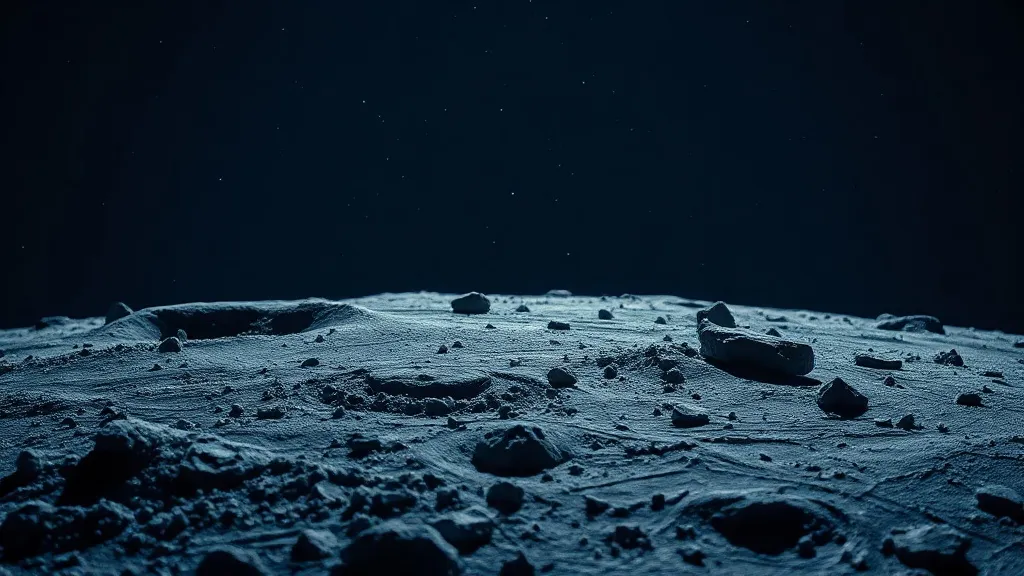
A new arXiv preprint by Breakthrough Listen researcher Brian Lacki argues that Moon dust could harbor microscopic relics of extinct extraterrestrial megastructures scattered across the galaxy over billions of years.
The most promising place to search for evidence of extinct extraterrestrial civilizations may not be the distant reaches of the galaxy, but the lunar regolith beneath astronauts’ boots - and the right instrument for the job may be a laboratory microscope rather than a radio telescope.
That is the central argument of a new preprint posted to arXiv in June 2026 by Brian C. Lacki, a researcher at the Breakthrough Listen initiative and the University of Oxford’s Department of Physics. The paper, titled “Dust to Dust: Prospects for Passive Technosignatures as Relics of ETI,” proposes that Moon dust could preserve microscopic fragments shed by ancient alien megastructures that drifted through our solar system over billions of years.
The Temporal Overlap Problem
Standard SETI searches monitor stars for radio or laser signals from civilizations broadcasting right now. But Lacki identifies a fundamental constraint: humanity’s own detectable radio presence has lasted only around 100 years. On cosmic timescales, the odds of two civilizations existing simultaneously and one actively transmitting in the right direction are low. Passive technosignatures - structures that require no maintenance and persist after their builders are gone - sidestep this problem entirely.
As Lacki notes in the paper, civilizations capable of building galaxy-scale engineering may be separated from each other by millions of years rather than existing in parallel. The ruins of their technology, the argument goes, are far more probable targets than live signals from contemporary builders.
What Advanced Civilizations Might Leave Behind
The paper examines three categories of large-scale engineering a civilization might construct: diffusers, which scatter starlight to alter a star’s apparent brightness; occulters, which periodically block starlight to send signals to distant observers; and glinters, reflective structures that flash sunlight across interstellar distances.
Any such megaswarm would not last indefinitely. Lacki calculates that an occulter swarm has a collisional lifetime of approximately one million years before individual components begin destroying each other in a self-perpetuating cascade - the same dynamic, operating at planetary scale, as the Kessler syndrome that threatens Earth’s orbital environment. A lens swarm degrades even faster, on timescales of around 100,000 years, according to the paper.
Once the components are ground below micron-scale, radiation pressure from a host star exceeds gravity, ejecting the debris into interstellar space. As our solar system orbits the Milky Way every 225 million years or so, it sweeps through interstellar material - including, potentially, what Lacki calls “technograins”: micron-scale particles that were once components of alien engineering.
Why the Moon Is the Optimal Archive
Most planets are geologically active. Erosion, volcanism, and plate tectonics continuously overturn and destroy surface material. The Moon is not geologically active, and has remained largely stable for billions of years while continuously receiving infalling interstellar material.
“Micron-scale fragments,” the paper states, “may land softly enough in the regolith of worlds like the Moon to maybe be recognizable even over billions of years.”
Searching for such particles would not necessarily require new space infrastructure. The Apollo missions returned approximately 382 kilograms of lunar material, samples from which continue to be studied using modern analytical techniques. Lacki suggests that microscopic analysis of lunar regolith - screening particles for anomalous elemental compositions or structural geometries inconsistent with natural origin - could form a new branch of technosignature research.
Detection Probabilities and Open Questions
The numbers Lacki calculates for other passive technosignature methods are not encouraging. A reflective glinting mirror of 100 square centimetres might in principle be detectable at 1 AU using the Vera C. Rubin Observatory’s Legacy Survey of Space and Time, but with a per-observation detection probability of roughly 5 in a million, according to the paper.
A key challenge acknowledged in the study - but largely deferred to a companion paper by Pinault et al. (2026) - is the recognition problem. Even if technograins arrived in the lunar regolith, distinguishing them from natural cosmic dust would require criteria that have not yet been established. The paper does not identify any candidate particles in existing lunar samples, and does not claim that any such artifacts have been found.
What This Paper Claims and Does Not Claim
This is a theoretical proposal, not a detection. The paper is a mathematical and physical argument for where passive relics might accumulate if large-scale alien engineering ever existed, and makes no claim about whether it did. As Lacki writes, “the chances of us overlapping in time with any such civilization are miniscule,” which is precisely the motivation for looking at long-lived passive records rather than active signals.
The idea of searching our own solar system for physical evidence of extraterrestrial intelligence has appeared in the scientific literature before. The Bracewell-von Neumann probe concept, formulated in the 1960s, proposed that advanced civilizations might seed the galaxy with self-replicating messenger probes, some of which could be dormant in the solar system now. The Galileo Project at Harvard University has explicitly included solar system artifact searches in its research programme alongside its atmospheric sensor network.
What Lacki’s paper contributes is quantitative modelling of the lifecycle of megastructures and an argument for where their debris would be most likely to accumulate in detectable form - arriving at the Moon as the most stable and accessible repository within reach of existing sample collections.
Whether the next significant result in the search for extraterrestrial intelligence comes from a radio dish, a space telescope, or a scanning electron microscope analysis of Apollo-era lunar samples remains to be determined. The paper argues only that the third option deserves serious consideration.