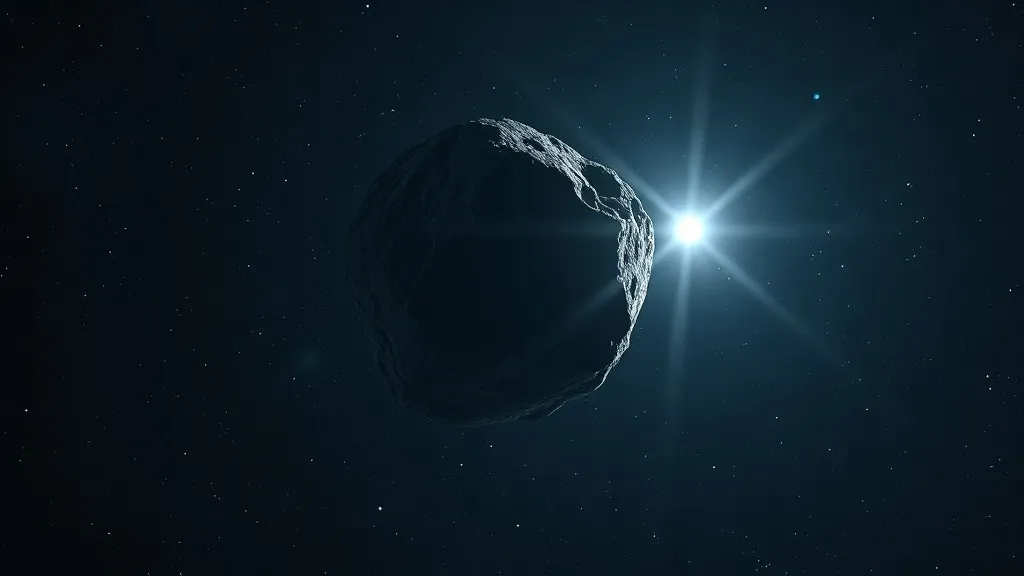
The Lucy spacecraft's 2025 flyby of a main-belt asteroid has produced a detailed portrait of a doubly-tumbling, bilobate rock with iron-rich clays - evidence of liquid water from 155 million years ago.
NASA’s Lucy spacecraft has revealed that asteroid Donaldjohanson is a peanut-shaped, doubly-tumbling body with iron-rich clay minerals pointing to a brief episode of ancient liquid water - making it a distinctively different specimen from every other carbonaceous asteroid studied up close, and adding a third data point to scientists’ growing comparison set.
The findings, announced by the Southwest Research Institute (SwRI) and NASA on June 18, 2026, draw on data collected during Lucy’s April 20, 2025, encounter with the half-mile-wide asteroid in the inner main belt between Mars and Jupiter. More than a year of detailed analysis produced multiple papers covering shape, rotation, composition, and formation history.
A peanut with a complicated origin
Donaldjohanson’s most striking feature is its shape. Lucy’s cameras confirmed what Earth-based telescopes had suggested: the asteroid is bilobate - two distinct rocky lobes joined by a narrow neck. According to the NASA announcement, scientists believe the lobes are fragments from a larger parent body that collided and then merged under their mutual gravity approximately 155 million years ago. That makes Donaldjohanson considerably younger than the best-studied carbonaceous asteroids: Bennu and Ryugu are each estimated to be 1 to 2 billion years old.
The asteroid carries its name from paleontologist Donald Johanson, who discovered the famous fossilised hominin known as “Lucy” in Ethiopia in 1974 - the ancient ancestor for whom the spacecraft is named.
A double wobble
Rather than spinning steadily on a single axis, Donaldjohanson tumbles in a more complex pattern. According to NASA, the asteroid rotates end-over-end once every 10.5 Earth days while simultaneously wobbling around its long horizontal axis every 26.5 days. This non-principal-axis rotation - sometimes described as excited or tumbling spin - is thought to be a residual signature of the ancient collision that built the body.
The asteroid has also been slowing down significantly. NASA estimates Donaldjohanson rotated at least ten times faster when it formed, and has been decelerating for the past 20 to 60 million years. The driving mechanism is the YORP effect - solar energy absorbed by the surface and re-emitted as infrared radiation exerts tiny recoil forces that, over geological timescales, alter the spin rate of an asymmetric body. Because Donaldjohanson’s two-lobed shape lacks rotational symmetry, the effect acts as a consistent brake.
Water, briefly
Perhaps the most scientifically significant finding concerns the minerals Lucy’s infrared spectrometer detected on the surface: iron-rich clays. According to the SwRI press release, the presence of these clays is evidence that liquid water was once present on, or within, the parent body from which Donaldjohanson formed.
The distinction from previously studied asteroids is notable. Bennu and Ryugu both carry magnesium-rich phyllosilicates - clay types that geochemists associate with prolonged aqueous alteration lasting millions of years. Donaldjohanson’s iron-rich clays suggest a briefer exposure to water, pointing to a different early history even among asteroids thought to originate from similar carbon- and water-rich parent bodies.
Dr. Simone Marchi, Lucy’s deputy principal investigator at SwRI, said in the press release: “It’s helpful for scientists to compare Donaldjohanson with asteroids like Bennu and Ryugu. Every subtle difference is another clue.”
What drove the different water histories - whether the parent body’s size, its internal heat sources, or its distance from the young Sun - remains an open question.
A test run that exceeded expectations
The April 2025 flyby was explicitly conceived as an instrument validation exercise before Lucy’s primary mission objective: the Jupiter Trojan asteroids, ancient bodies that share Jupiter’s orbit and are considered some of the most pristine relics from the solar system’s formation. Lucy’s first Trojan encounter is scheduled for 2027.
That a rehearsal flyby has already produced detailed data across shape, rotation, composition, and water history illustrates how much information a well-instrumented spacecraft can gather even in a brief pass. Scientists now hold a third close-range portrait of a carbonaceous asteroid alongside Bennu and Ryugu - and the picture that emerges is one of meaningful variety rather than uniformity.
Whether Donaldjohanson’s parent body formed in the same primordial reservoir as Bennu and Ryugu, or originated in a different part of the early solar system and migrated inward, is a question the new clay-mineralogy data is expected to help constrain in future studies.