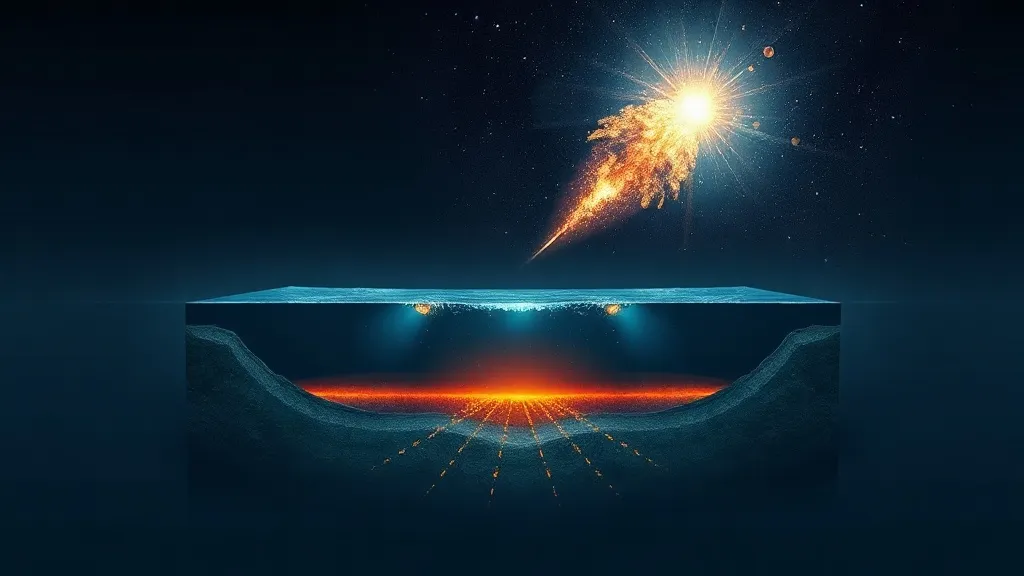
A study in Nature Astronomy has identified hundreds of atoms of plutonium-244 in a 1976 Pacific Ocean crust sample, providing evidence that debris from a kilonova - a neutron star merger - has been steadily raining on Earth for over 100 million years.
Scientists have detected hundreds of atoms of plutonium-244 in a fragment of Pacific Ocean seafloor rock, pointing to a kilonova - the cataclysmic merger of two neutron stars - that sent radioactive debris raining through the solar system more than 100 million years ago. The findings, published June 15, 2026 in Nature Astronomy, represent the clearest geological evidence to date that Earth has been receiving fallout from an ancient stellar explosion for far longer than any complex life has existed on the planet.
The research was led by Dr. Dominik Koll and Professor Anton Wallner at the Helmholtz-Zentrum Dresden-Rossendorf (HZDR) in Germany, in collaboration with Dr. Michael Hotchkis and colleagues at the Australian Nuclear Science and Technology Organisation (ANSTO) and the Australian National University.
What the rock contains - and what it doesn’t
The sample at the centre of the study is a 1.9-kilogram ferromanganese crust dredged from the Pacific Ocean in 1976, from a depth of 4,830 metres. These crusts grow extraordinarily slowly - at only a few millimetres per million years - which makes them useful geological archives of material that has settled out of seawater across deep time. A three-centimetre core can span more than 10 million years of history.
Using accelerator mass spectrometry, the team detected a few hundred atoms of plutonium-244 (Pu-244) per kilogram of crust. That quantity is vanishingly small - but what matters is what those atoms imply. Pu-244 has a half-life of 81 million years. Its presence tells researchers that a Pu-244-producing event occurred within approximately the last billion years.
More telling is what the team did not find. Curium-247, another transuranium element produced alongside plutonium during rapid neutron capture - the so-called r-process - carries a much shorter half-life of only 16 million years. Despite the team having superior detection sensitivity for Cm-247, none was present. According to Dr. Hotchkis, that absence “tells us it happened a very long time ago - but not more than about 1 billion years ago; otherwise the plutonium-244 would also be undetectable.”
The two constraints together place the event somewhere between roughly 100 million and one billion years ago.
The kilonova explanation
The leading candidate source, according to the authors, is a kilonova - the violent collision of two neutron stars. When two neutron stars spiral inward and merge, they release an enormous burst of energy and create a brief but extraordinarily dense environment of free neutrons. That neutron bath drives r-process nucleosynthesis: the rapid assembly of atomic nuclei into elements heavier than iron, including gold, platinum, uranium, and plutonium. Kilonovae are thought to account for roughly half of all the heavy elements currently present in the universe.
The HZDR team argues that debris from such a kilonova diffused through the interstellar medium and eventually reached the solar neighbourhood. Professor Wallner, who has documented similar evidence for more recent stellar events - traces of iron-60 in oceanic crust linked to supernovae approximately 2.5 and 7 million years ago - described the plutonium as having “dispersed throughout the interstellar medium.” The Pu-244 signal represents a far older and more distant explosion than those younger iron-60 deposits.
What remains uncertain
The authors are measured about what the data do not establish. The kilonova identification is the leading candidate, not a confirmed origin. Other astrophysical scenarios capable of producing r-process elements - certain rare classes of core-collapse supernovae, for instance - cannot be entirely ruled out with current data. The precise age and distance of the event are constrained only within a wide range, and the exact mechanism by which stardust settled into Pacific ferromanganese over geological timescales is not fully characterised.
Whether the kilonova fallout had any measurable effect on life or geological processes on Earth, Dr. Hotchkis told ANSTO’s science communications team, is “an open question, to be investigated in further research.”
What comes next
The researchers point toward a broader programme: analysing additional deep-sea crust samples from different time periods and ocean locations to track the frequency and intensity of such debris arrivals. The same samples could, in principle, hold records of multiple ancient cosmic events layered across millions of years.
If similar traces of Pu-244 or other r-process isotopes appear in lunar regolith samples - which lack Earth’s weathering processes and represent an uninterrupted cosmic dust archive going back billions of years - the record could extend much further into the past. As the study demonstrates, the seafloor already holds a remarkably detailed archive of the solar neighbourhood’s violent history, preserved in a rock the size of a modest paperweight, pulled from the bottom of the Pacific nearly five decades ago.