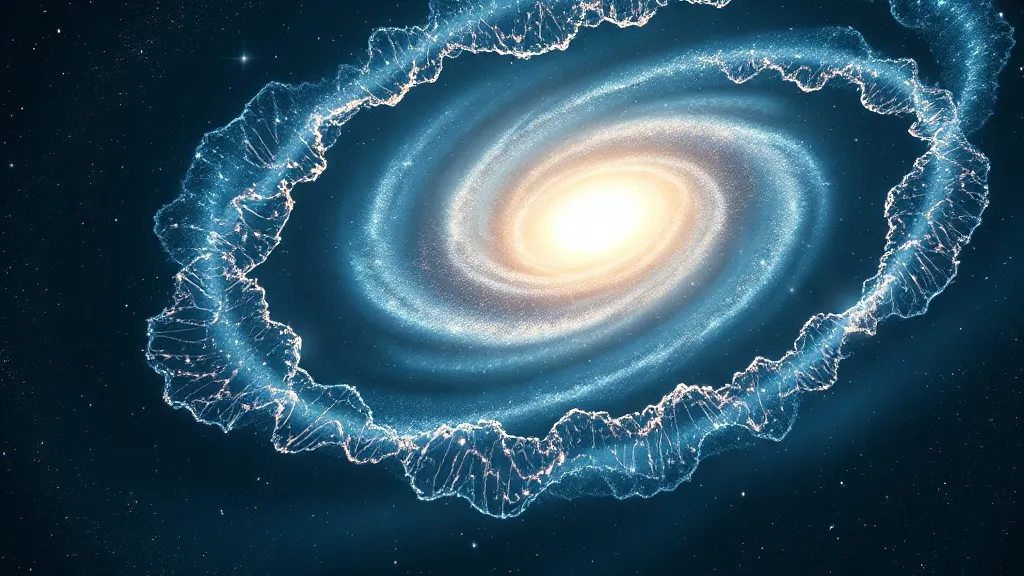
New JWST observations of NGC 4696 have traced, for the first time, how galaxy-spanning filaments of cooling gas connect to a rotating circumnuclear disk that funnels material toward a supermassive black hole - closing a long-standing gap in black hole physics.
Astronomers using the James Webb Space Telescope have traced, for the first time, the complete feeding pathway of a supermassive black hole - establishing that galaxy-spanning filaments of cooling gas flow into a compact rotating disk, which in turn funnels material toward the black hole’s centre. The findings, posted to arXiv on June 4, 2026, and submitted to The Astrophysical Journal, provide what the research team describes as the “missing link” between large-scale galaxy cluster physics and the intimate mechanics of black hole accretion.
What the Telescope Found
The target was NGC 4696, the central and most luminous galaxy of the Centaurus galaxy cluster, located approximately 170 million light-years from Earth. The galaxy sits within a spectacular network of gaseous filaments extending tens of kiloparsecs in every direction - structures previously observed in X-ray, optical, and radio wavelengths. The question that had remained unanswered was precisely how material in those filaments eventually reaches the black hole.
Using JWST’s Near-Infrared Spectrograph (NIRSpec), the research team observed the innermost region of NGC 4696 at a resolution of 10 parsecs per pixel - roughly 33 light-years. Within that field, a structure previously catalogued as an unusual ionized swirl near the galaxy’s centre was resolved in detail for the first time: a rotating, multiphase circumnuclear disk (CND) roughly 618 parsecs in diameter, sitting between the large-scale filament network and the black hole itself.
The JWST data show that the CND is physically and kinematically connected to the surrounding filaments. According to the paper, gas flows inward from the wider network, enters the rotating disk, loses angular momentum, and is channelled toward the black hole’s sphere of influence. The paper describes this as the first observational closure of the AGN feedback loop - the self-regulating cycle in which galaxy clusters cool, their central black holes consume gas, and the energy released by that accretion feeds back into the cluster environment, slowing further cooling.
Why This Has Been Hard to Observe
Resolving a supermassive black hole’s feeding mechanism requires observing material across an enormous range of spatial scales at once. The filaments that supply the gas stretch over tens of thousands of light-years; the circumnuclear disk sits within a few hundred light-years of the black hole; and the black hole’s direct accretion zone is smaller still. Previous facilities lacked the combination of spatial resolution and infrared sensitivity to probe the inner region in sufficient detail. JWST’s NIRSpec instrument, operating in the near-infrared where certain ionized gas tracers are particularly luminous, was able to resolve structures below the threshold of earlier telescopes.
The research team supported the observational findings with magnetohydrodynamic simulations tailored to NGC 4696, which reproduced the observed morphology and kinematics. In those models, filamentary gas condenses from the hot cluster atmosphere, loses angular momentum as it flows inward, and accumulates in the rotating CND before being accreted - a sequence that matches the JWST observations closely, according to the paper.
Evidence From a Second Cluster
The researchers applied a comparable analysis to NGC 1275, the central galaxy of the Perseus galaxy cluster and another well-studied system of the same type. A similar circumnuclear disk structure appears to be present there as well, according to the paper, pointing to a common mechanism across different cluster environments. The BBC Sky at Night Magazine, reporting on the findings, described the result as indicating that “black holes feed themselves” through this recycled gas network - a description reflecting both the self-regulating nature of the process and the scale at which it operates.
The consistency across two prototypical systems strengthens the case that the CND-filament connection is not a peculiarity of NGC 4696 but a general feature of how supermassive black holes grow in galaxy clusters, according to the paper. Universe Today, covering the research, described the circumnuclear disk as “the missing link between black hole accretion and the flow of cool gas that feeds it.”
What Remains Uncertain
The paper is a preprint that has been submitted for peer review but has not yet completed that process. The findings are framed by the authors as consistent with a particular class of accretion model; the specific processes governing how gas transitions from the CND to the black hole’s direct accretion zone - at distances below the resolution of current JWST observations - remain a subject of simulation rather than direct measurement.
The Centaurus cluster is approximately 170 million light-years from Earth. The resolution achieved by JWST’s NIRSpec in this observation - 10 parsecs per pixel - is among the finest yet achieved for a galaxy at this distance, according to the paper, but it does not reach the spatial scales at which individual accretion processes operate.
Significance for Black Hole Physics
The detection of this connection matters because it gives observational grounding to a theoretical framework that has, until now, rested largely on simulations and indirect evidence. Large-scale filamentary structures around the central galaxies of cool-core clusters have been observed for decades; what was missing was a direct observational link between those structures and the accretion-scale physics near the black hole. The circumnuclear disk identified in NGC 4696 provides that link.
The research adds to a growing body of JWST results that are allowing astronomers to probe galaxy evolution at finer spatial resolution than previously possible - and in this case, to close a gap in understanding how the universe’s most massive objects continue to grow.