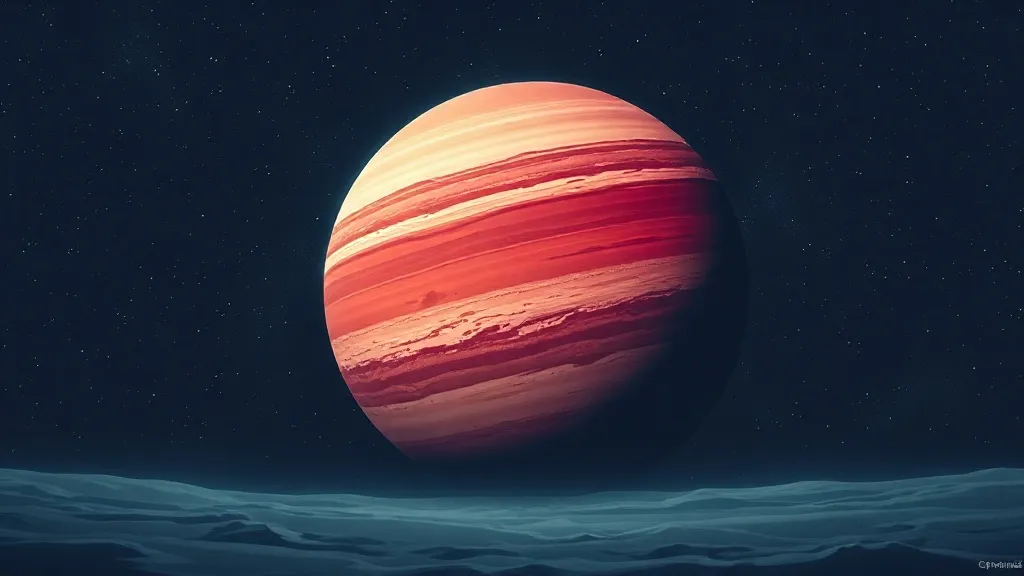
For the first time, astronomers have found that salt clouds are essential to explaining a planet's atmosphere. James Webb's two-hour study of GJ 504b could reshape how scientists model cold giant worlds.
The James Webb Space Telescope has produced the first confirmed spectroscopic detection of salt clouds in a planetary atmosphere, finding them in the cold gas giant GJ 504b - commonly called the “Pink Planet” - in a study published June 18, 2026 in The Astronomical Journal. The research, led by Aneesh Baburaj of Northwestern University, fills in a gap in our understanding of cloud types that can form in cold giant worlds and may require revisions to atmospheric models used across that class of objects.
GJ 504b has been an open puzzle since it was discovered via direct imaging in 2013. It orbits a sun-like star roughly 57 light-years from Earth and appears pink in visible light - an unusual colour that drew immediate attention. With a mass of approximately 25 times that of Jupiter and a surface temperature of around 290 degrees Celsius, it occupies a classification grey zone. At that mass, it sits above the roughly 13-Jupiter-mass threshold traditionally associated with deuterium-burning brown dwarfs, but astronomers note that mass alone is insufficient to settle the question - formation mechanism also matters, and GJ 504b’s origin remains unclear. The “planetary-mass companion” designation reflects that unresolved uncertainty rather than papering over it.
Thirteen years, two hours
Since its discovery, multiple teams using the world’s largest ground-based observatories had attempted to characterise GJ 504b’s atmosphere, often spending entire observing nights trying to extract faint spectral signals from behind the host star’s glare. None succeeded in producing a usable atmospheric spectrum.
Webb accomplished the same task in two hours.
Using JWST’s Near Infrared Spectrograph, Baburaj’s team identified a mix of molecules in the atmosphere: water, carbon dioxide, methane, and ammonia were all detected. When the team tried to match the full spectrum using standard cloud models, however, none fit. They tested three different cloud types before the data fell into place: salt clouds, buried deep in the atmosphere, provided the best match.
According to the study, those salt clouds appear to suppress the spectral signatures of molecules hidden beneath them - an effect that had been confounding earlier attempts at ground-based characterisation. “This is the first time we’ve found that salt clouds are critical to explaining the spectrum of an object,” Baburaj said, according to Northwestern University’s research news office.
Why salt clouds matter beyond one odd planet
Salt clouds occupy a specific niche in the temperature hierarchy of planetary atmospheres. Where it is too hot for water or ammonia clouds to condense but too cool for the silicate clouds seen in hotter gas giants, salts can form instead. GJ 504b sits in exactly that temperature band.
The implication is significant because many of the coldest directly imaged giant planets and brown dwarfs known to astronomers fall into similar temperature ranges. If salt clouds are a common feature of these objects, current atmospheric models for that population may be systematically misreading their spectra - underestimating cloud cover and misattributing the suppression of molecular features.
The paper notes a possible metal enrichment in GJ 504b’s atmosphere relative to solar composition, but the authors treat that finding as tentative and flag the need for additional observations before drawing firm conclusions.
What Webb confirmed - and what it did not
The new study settles the question of what clouds dominate GJ 504b’s upper atmosphere. It does not resolve the planet’s fundamental identity. At 25 Jupiter masses, GJ 504b remains genuinely ambiguous - a world defined as much by what we do not yet know about how it formed as by what we have now measured about where it sits in the sky.
What is no longer ambiguous is that salt clouds, until now hypothetical in this context, have a confirmed presence in at least one planetary atmosphere 57 light-years from Earth. For the wider field of directly imaged cold giants, that is a result that is likely to matter well beyond GJ 504b itself.