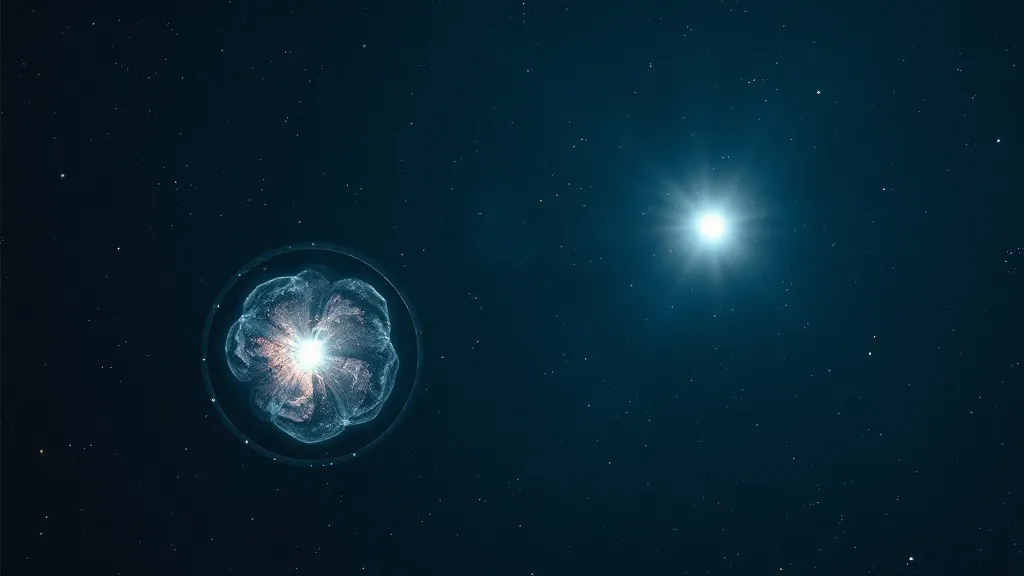
For the first time, astronomers have traced two supernova remnants - the Jellyfish Nebula (IC 443) and its neighbor G189.6+3.3 - back to the same binary star system, roughly 6,000 light-years from Earth in the constellation Gemini.
NASA’s Fermi Gamma-ray Space Telescope has confirmed the first known pair of supernova remnants born from a binary star system - two massive stars that lived as gravitationally bound companions and both died in cataclysmic explosions thousands of years apart. The findings were presented at the 248th meeting of the American Astronomical Society in Pasadena on 17-18 June 2026 and accepted for publication in Nature Communications.
The two remnants are the Jellyfish Nebula (IC 443) - one of the most studied supernova remnants in the sky, located approximately 6,000 light-years from Earth in the constellation Gemini - and its older, far fainter neighbor, G189.6+3.3. According to the research team, the Jellyfish Nebula is estimated to be 8,000 to 9,000 years old, while G189.6+3.3 exploded between 20,000 and 110,000 years ago. The two objects are separated by roughly 40 light-years in projection.
“There are so many striking connections between the two remnants that we conclude they’re likely related,” said lead researcher Miltiadis Michailidis, a postdoctoral fellow at Stanford University’s physics department, in a NASA statement released 17 June 2026.
A Signal Hidden Inside a Signal
The connection was not obvious. G189.6+3.3 is far fainter than IC 443, and its gamma-ray signal had been buried in IC 443’s much brighter emission for decades. Using 16 years of Fermi Large Area Telescope data, Michailidis and colleagues modeled and subtracted IC 443’s gamma-ray contribution, uncovering a distinct and previously hidden source coinciding with the older remnant. Supporting X-ray evidence from the eROSITA satellite revealed a second expanding shell adjacent to the Jellyfish Nebula’s boundary.
Computer simulations of one million binary star system configurations showed that the probability of the two remnants being spatially aligned purely by chance is below 1 percent, according to NASA.
How a Binary System Produces Two Remnants
The researchers propose the following sequence. Two stars, each exceeding 20 times the mass of the Sun, formed as a gravitationally bound binary pair. The more massive star exhausted its fuel first and exploded as a supernova. That explosion - and the neutron star or black hole it likely left behind - affected the companion star, possibly stripping some of its outer layers or altering its orbital path. The surviving star eventually reached the end of its own life and exploded as well, leaving two overlapping remnants in roughly the same region of interstellar space.
Why It Matters for Cosmic Ray Physics
IC 443 has long been of particular interest to astrophysicists because its expanding shell slams into a dense nearby molecular cloud, accelerating protons to close to the speed of light. That process, known as diffusive shock acceleration, is one of the leading mechanisms proposed for the origin of cosmic rays - the high-energy particles that continuously bombard Earth from across the galaxy.
The identification of a sibling remnant changes the picture. “This discovery gives us a unique laboratory for studying how two shockwaves interact and amplify cosmic ray production,” Michailidis said, according to NASA. Two overlapping shock fronts, at different evolutionary stages, interacting with the same molecular cloud, may produce particle acceleration signatures that a single remnant cannot.
Co-authors include Marianne Lemoine-Goumard of the French National Centre for Scientific Research (CNRS) and the University of Bordeaux, and Elizabeth Hays of NASA’s Goddard Space Flight Center.
Broader Implications
The finding raises the question of how common binary supernova remnant pairs might be. The majority of very massive stars - those above roughly 15 to 20 solar masses, which are the stars most likely to end as core-collapse supernovae - are estimated to spend at least part of their lives in binary or multiple-star systems. How the explosion of one affects the other, and whether paired remnants leave identifiable observational signatures, has until now been largely theoretical.
Michailidis’s team suggests that additional binary remnant pairs may exist near other well-studied supernova remnants, hidden in the same way G189.6+3.3 was: outshone by a brighter companion and only detectable once that companion’s signal is carefully modeled and removed. The Jellyfish Nebula, one of astrophysics’ best-studied objects, had concealed its sibling for decades.