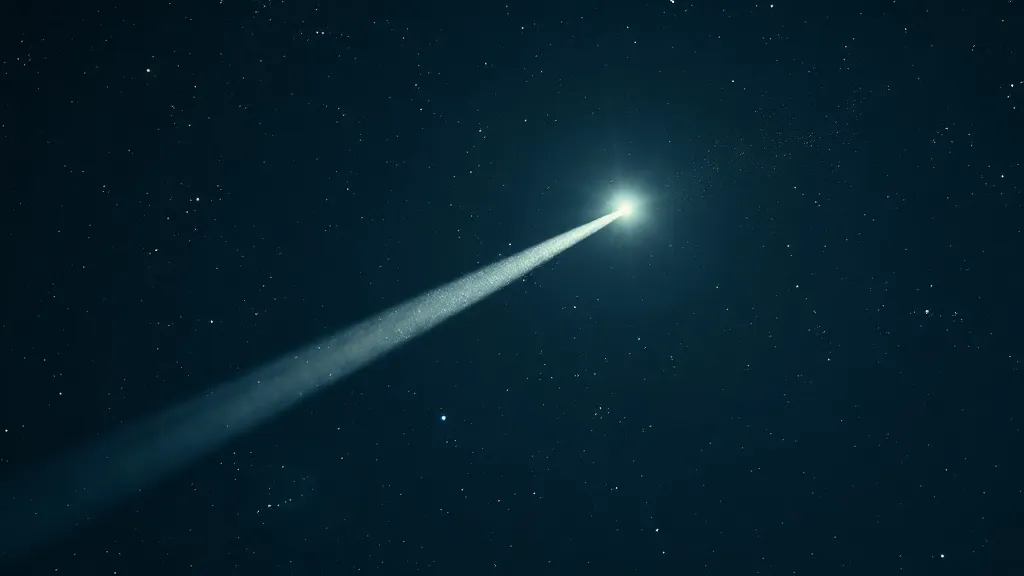
A Jupiter-family comet that brightened roughly 8,000-fold in under 14 hours has reached perihelion, offering northern hemisphere observers a binocular window in the pre-dawn sky this week.
Comet 220P/McNaught arrived at perihelion on June 14, 2026, completing its closest approach to the Sun two weeks after producing what astronomers describe as the second-brightest cometary outburst in the historical record. The sudden eruption brightened the comet roughly 8,000-fold in under 14 hours, according to Universe Today.
The outburst was detected between the final hours of May 30 and the first hours of May 31, 2026. Astronomer Mike Kelley, using archival images from the Zwicky Transient Facility (ZTF) survey at Palomar Observatory, first flagged the event on June 1. A formal report, ATel #17829, followed on June 3, co-authored by Kelley and colleagues from the ZTF programme.
Prior to the eruption, 220P/McNaught sat at a routine magnitude 18 - well beyond the reach of binoculars or amateur telescopes. At its peak, according to Astronomy.com, the comet brightened to approximately magnitude 8. That shift of nearly 10 magnitudes represents a several-thousand-fold increase in received light; on the logarithmic scale used in astronomy, each step of five magnitudes equals a hundredfold difference in brightness.
Only one cometary outburst in the documented history of the field is known to have exceeded it: Comet 17P/Holmes in October 2007, which brightened by roughly one million times and briefly reached approximately third magnitude - visible to the naked eye across the Northern Hemisphere, according to Universe Today. The 220P/McNaught event surpasses the previous second-place holder, a 2013 outburst of Comet 289P/Blanpain.
Cometary outbursts of this scale are caused by a rupture in the icy outer crust of the nucleus. As a comet approaches the Sun, volatile gases trapped beneath the surface heat under pressure until they force through, ejecting a large plume of dust. That plume dramatically expands the coma - the diffuse cloud surrounding the nucleus - creating a much larger reflective surface area and the temporary brightness spike observers recorded.
The distinction between an outburst and standard perihelion brightening matters scientifically. Ordinary brightening near closest approach reflects steady, predictable sublimation of surface ice. An outburst represents a discrete structural event - a sudden exposure of fresh volatile material, or possibly a partial collapse of the nucleus. That is why outbursts can occur at any point in the orbit and remain difficult to predict. The 220P/McNaught event occurred while the comet was still approximately two weeks from perihelion.
Follow-up observations by the TRAPPIST telescope network, reported in ATel #17838 on June 8 by E. Jehin, J. Manfroid, and colleagues, found that gas and dust production rates had dropped significantly from the outburst peak - suggesting a short-lived event rather than a sustained increase in activity. The TRAPPIST team also noted a narrow, intense dust tail in their imaging data, a possible indicator of partial fragmentation of the nucleus. That interpretation has not been confirmed.
220P/McNaught is a Jupiter-family comet, a class with orbital periods shorter than 20 years, strongly shaped by Jupiter’s gravitational influence. It orbits the Sun roughly every 5.5 years, reaching perihelion at approximately 1.6 astronomical units - just outside the orbit of Mars, according to Universe Today.
As of June 13, the comet had faded from its magnitude-8 peak to approximately magnitude 12, according to Astronomy.com - still far above its pre-outburst baseline of magnitude 18. Northern hemisphere observers can locate it in the constellation Pisces, roughly 4.7 degrees west of Saturn. The best viewing window is about two hours before dawn, when the comet climbs to nearly 20 degrees above the eastern horizon. Binoculars or a small telescope are sufficient at this brightness; Saturn’s proximity provides a convenient navigational reference.
Whether the comet will produce secondary outbursts remains unknown. Survey instruments including the ZTF are expected to continue monitoring it through and beyond the current perihelion passage.