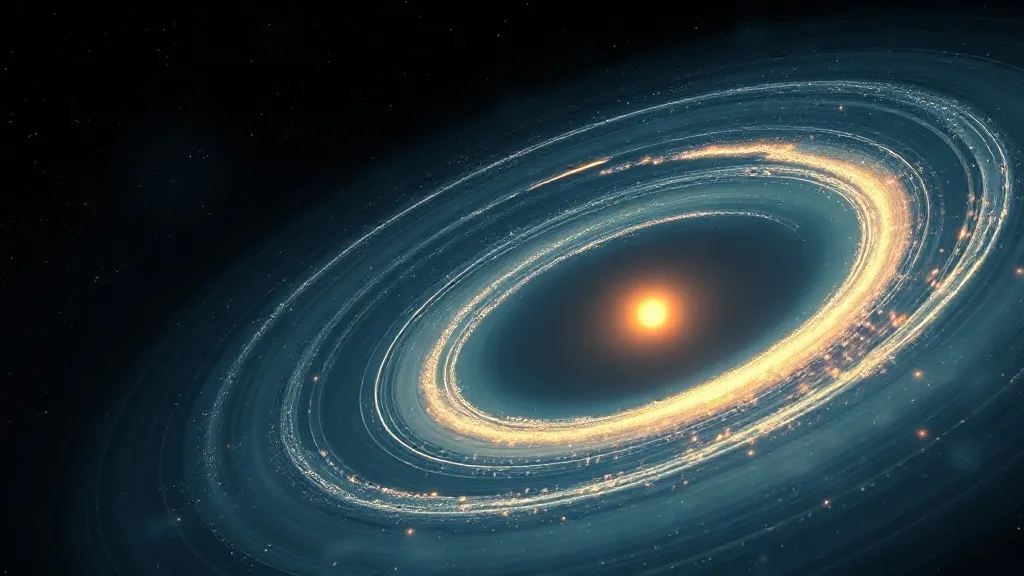
A team led by CNRS researchers used ESO's VLT/SPHERE instrument over four years to directly map the rotation of the protoplanetary disk around AB Aurigae - the first such observation - revealing accretion zones that indicate giant planets are actively forming inside it.
Astronomers have directly observed the rotation of a protoplanetary disk for the first time, mapping how the ring of gas and dust surrounding the young star AB Aurigae is moving - and finding regions where the motion deviates from what physics predicts, pointing to the active formation of giant planets inside it.
The findings were published June 1, 2026 in Astronomy & Astrophysics by a team led by Anthony Boccaletti, a research director at CNRS and the Paris Observatory - PSL. Using the SPHERE instrument on the European Southern Observatory’s Very Large Telescope in Chile, the researchers conducted three observational campaigns across four years, tracking the motion of dust grains embedded in the disk by mapping their infrared emissions. According to the CNRS press release accompanying the paper, this is the first time a protoplanetary disk’s rotation has been directly observed in this way.
What a protoplanetary disk is
A protoplanetary disk is the rotating envelope of gas, dust, and ice that encircles a young star before its planetary system has fully assembled. In our own solar system, an equivalent disk surrounded the young Sun roughly 4.6 billion years ago and gave rise to the planets, moons, and minor bodies we observe today. Around other stars, these disks are detectable only with high-contrast instrumentation capable of suppressing the overwhelming glare of the central star.
AB Aurigae is a young, pre-main-sequence star known as a Herbig Ae object, located approximately 470 light years from Earth in the constellation Auriga. At an estimated age of 1 to 3 million years, it is at the stage of stellar development when active planet formation is expected to be ongoing.
What SPHERE revealed
SPHERE - Spectro-Polarimetric High-contrast Exoplanet REsearch - is installed on ESO’s Very Large Telescope at Cerro Paranal, Chile. The instrument uses advanced coronagraphs and adaptive optics to achieve near-infrared imaging at resolutions sufficient to resolve disk substructure around nearby young stars.
By comparing images taken over four years, the research team tracked how dust structures within the disk shifted position, effectively measuring the disk’s rotation directly over time. The disk’s overall motion conforms to Keplerian physics: inner material orbits faster than outer material, following the same gravitational laws governing planetary orbits. But two categories of anomaly appear in regions close to the star and diverge from what models had forecast.
The first is a bright structure consistent with an accretion zone - a region where gas and dust are concentrating and falling inward toward a forming object. The authors note that accretion zones of this kind are characteristically associated with the growth of giant planets.
The second anomaly is a set of faint shadows rotating rapidly across the disk surface. According to the research team, these are most likely cast by opaque structures orbiting close to the star - possibly forming protoplanets or dense dust concentrations moving faster than the outer disk beneath them.
The paper’s authors describe the overall disk behaviour as “more complex than those predicted by theoretical models,” concluding that the evidence points to multiple giant planets forming within the system.
A known planet and evidence of others
The AB Aurigae system was already a candidate for direct planet imaging before this study. According to Universe Today’s reporting on the research, the object designated AB Aurigae b - a gas giant candidate estimated at roughly nine times the mass of Jupiter - sits at approximately 93 astronomical units from the star and has been tracked in archival Hubble Space Telescope data over more than 13 years, showing counterclockwise orbital motion consistent with a gravitationally bound companion.
The new SPHERE observations address different territory. The accretion structure identified in the study sits at roughly 30 astronomical units from the star - closer in than AB Aurigae b - and the rapidly rotating shadows hint at additional forming objects at a range of separations across the disk. The researchers also identified two further protoplanetary candidates at 400 to 600 astronomical units, appearing as dense clumps at wide separations from the star.
Protoplanetary disks have been studied since the Hubble era, but directly measuring their rotation - as opposed to imaging their static structure - has remained technically difficult. The SPHERE observations show that high-contrast infrared tracking of dust grain motion can reveal disk dynamics invisible to other methods, including signatures of planets that have not yet fully separated from the surrounding material.
For researchers studying how planetary systems form, the AB Aurigae disk now serves as a real-time laboratory. The complexity it exhibits is exceeding current theoretical predictions, a result that may drive revisions to existing models of how giant planets acquire mass and reshape the disks that surround them. The next generation of large ground-based and space-based observatories may be able to follow what SPHERE began: watching a planetary system take shape, in motion, around a star other than our own.