Seventy-four years ago this week, multiple radars tracked unknown objects over Washington's restricted airspace on two consecutive weekends. The Air Force scrambled jets twice. The official explanation was disputed by its own experts - and rejected by a scientific review.
Just before midnight on July 26, 1952, an Air Force pilot named William Patterson was flying his F-94 Starfire interceptor over Washington DC when controllers vectored him toward unidentified contacts on their radar. Patterson looked out of his cockpit and saw them: white lights, moving.
Then he radioed in: “They’re all around me.”
He was at maximum speed. The lights didn’t run - they outpaced him, then vanished. He asked ground control for permission to open fire. The answer was no. Nobody knew what he was looking at.
Patterson returned to base without an answer. The incident was the second in eight days. By the following Tuesday, the Air Force was holding the largest Pentagon press conference since the end of World War II.
What the Radars Saw
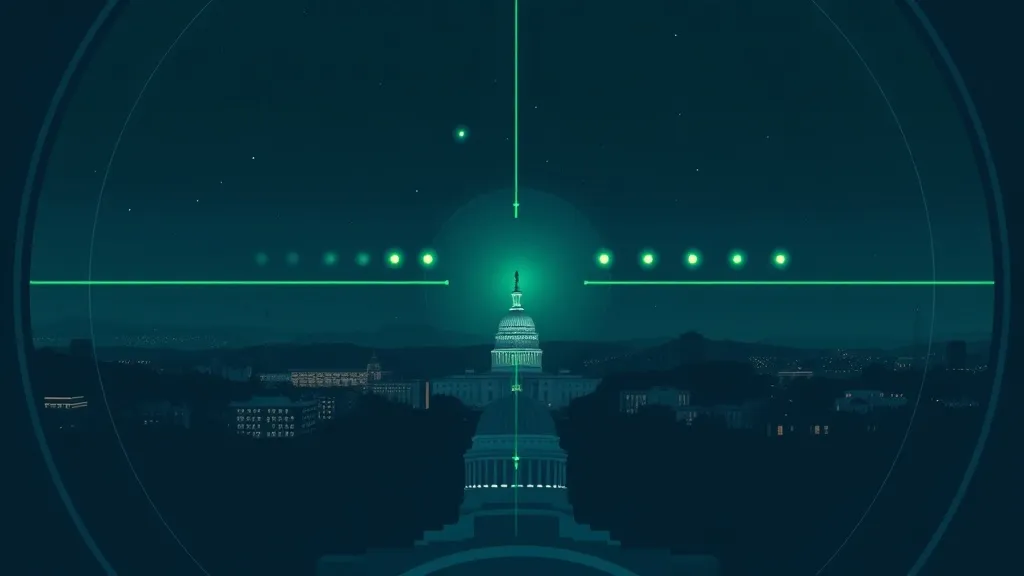
At 11:40 p.m. on Saturday, July 19, 1952, air traffic controller Edward Nugent was at his scope at Washington National Airport when seven objects appeared that should not have been there. They were located about 15 miles south-southwest of the city. No aircraft were scheduled in the area. The objects were not following any established flight path.
Nugent called his supervisor, Harry Barnes, a senior controller with long experience reading radar. Barnes watched the screen and later wrote: “We knew immediately that a very strange situation existed. Their movements were completely radical compared to those of ordinary aircraft.”
Barnes called the airport’s radar-equipped control tower. Controllers Howard Cocklin and Joe Zacko confirmed the same unidentified returns on their own scope. Cocklin also reported seeing a bright hovering light outside that he said departed at incredible speed.
As the night continued, blips began appearing across every sector of Barnes’s display. The objects moved slowly at times - then reversed direction or accelerated to speeds that, when calculated, reached 7,000 mph (11,250 km/h). No aircraft of the era came close to that. F-94 jets were scrambled from New Castle Air Force Base in Delaware, about 100 miles away. Each time they arrived over Washington, the contacts vanished from radar. Each time the jets returned to base, the blips came back.
The Second Weekend
One week later, on the night of July 26-27, the objects returned in greater numbers.
This time, fighters from Andrews Air Force Base - just outside Washington - were scrambled more quickly. Patterson located the lights and pursued them at maximum throttle. He could not close the distance. After his radio call to ground control, the contacts disappeared.
Watching events unfold was Albert Chop, the Air Force’s own press spokesman, who had positioned himself in the Washington National Airport control room to monitor the situation firsthand. He later said publicly that what he witnessed could not be explained by conventional aircraft.
Major Dewey Fournet, the Pentagon’s official liaison for Project Blue Book - the Air Force’s formal UFO investigation program - was also present in the radar room that night. Afterward, Fournet told Project Blue Book’s head, Captain Edward Ruppelt, that no one in the control tower believed the returns were weather-related.
Ruppelt himself had been on vacation when the first wave occurred. He cut it short and rushed back to Washington. He later described the 1952 incidents as among the most difficult cases Project Blue Book ever examined.
The Explanation That Didn’t Hold
On July 29, 1952, Major General John Samford, the Air Force’s Director of Intelligence, convened the largest Pentagon press conference since World War II. He offered an explanation: temperature inversions.
A temperature inversion is a meteorological condition in which a layer of warm air sits above cooler air. Under certain conditions, radar waves can refract toward the ground and return signals from ordinary objects, a phenomenon called anomalous propagation. Samford said the Washington radar contacts were caused by this effect. Visual sightings, he said, were misidentified stars and meteors.
The people who had been in the room did not accept the explanation. Barnes said the inversion present that night was far too weak to produce the returns his team had tracked. Lieutenant John Holcomb, a Navy radar specialist brought in specifically to review the data, agreed: there was a slight inversion, but it was “not strong enough to produce such convincing radar targets.” Fournet later confirmed that no one in the tower that night had believed the blips were weather phenomena.
The formal rebuttal came 17 years later. The Air Force commissioned an independent scientific investigation of UFO sightings, led by physicist Edward Condon of the University of Colorado. Examining the temperature-inversion claim specifically, the resulting Condon Report concluded that atmospheric conditions of the type and magnitude Samford described “do not occur in the Earth’s atmosphere.”
Project Blue Book officially classified several Washington cases as “unidentified.” The designation was never changed.
The Consequence Nobody Saw
After Samford’s press conference, UFO reports across the United States fell from roughly 50 per day to 10. The press accepted the weather story. The public moved on.
Behind the scenes, the Washington incidents alarmed the Central Intelligence Agency. In December 1952, the CIA reviewed Project Blue Book’s files and recommended a formal scientific panel evaluation. The result was the Robertson Panel, convened in January 1953 and named for its chair, physicist Howard Robertson. The panel spent four days reviewing the strongest UAP cases on record, including Washington.
The panel concluded that UFOs posed no direct threat to national security. But it warned that the volume of public UFO reports could overwhelm military communications channels and be exploited by the Soviet Union for psychological warfare. Its classified recommendation: the Air Force should actively reduce public interest in UFO sightings through systematic debunking. That recommendation quietly shaped official U.S. government policy for nearly two decades. The Robertson Panel’s existence remained classified until the late 1970s.
The original Project Blue Book case files are held today at the National Archives in Washington. Among them are the radar records from July 1952 - the contacts Nugent first noticed at 11:40 p.m. on a Saturday night. They remain marked, as they were when the Air Force closed the program in 1969, as unidentified.
Seventy-four years later, no revision has been made to that determination.