In December 1980, US Air Force personnel at twin NATO bases in Suffolk reported three nights of anomalous lights, physical ground traces, and radiation readings in the forest - producing the most detailed official record of any UAP event in British history.
In the early hours of 26 December 1980, a security patrol at RAF Woodbridge in Suffolk, England, noticed strange lights apparently descending into Rendlesham Forest, the dense woodland that bordered the base. What followed over the next three nights produced the most thoroughly documented official record of a UAP event in British history - one that remains unresolved in any formal government finding to this day.
RAF Woodbridge and the adjacent RAF Bentwaters were operated at the time by the United States Air Force under a NATO basing arrangement. The personnel who reported the lights were American servicemen.
Night One: The Initial Sighting
Around 03:00 on 26 December, USAF security patrol members - including Sergeant Jim Penniston and Airman John Burroughs - were dispatched after lights were spotted beyond the east gate. Penniston later described approaching a “craft of unknown origin” that he characterised as metallic, triangular, and warm to the touch. Airman Ed Cabansag, the third member of the patrol, described the phenomenon more cautiously, characterising the light as “a beacon light off in the distance.” Burroughs characterised it as resembling a lighthouse.
Local Suffolk Constabulary was called twice that night - at 04:00 and again at 10:30. Officers arriving at the site reported observing only the distant beam of the Orfordness Lighthouse, located approximately five miles to the east. The lighthouse, one of the most powerful on the Suffolk coast, flashes at a five-second interval and was visible through the trees.
The following morning, personnel found a small clearing where three indentations in the ground formed a triangular pattern, along with what was described as burn marks on tree bark and broken branches overhead. Local police noted the marks; a forestry worker who later examined the site described the “triangle” as three rabbit scrapes, characterising the surrounding broken branches as ordinary forest damage.
Night Three: Halt’s Investigation
The most consequential documentation came on the night of 27-28 December, when Lieutenant Colonel Charles I. Halt, the deputy base commander, led a team into the forest with radiation detection equipment and a portable Dictaphone. Halt recorded his observations in real time on micro-cassette tape as events unfolded - an unusual primary source that has since been publicly released and independently reviewed.
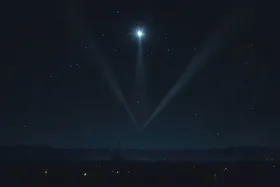
The 18-minute recording captures Halt and his team locating the ground impressions and taking readings with an AN/PDR-27 radiation survey meter. The three depressions registered approximately 0.07 milliroentgens per hour; surrounding background areas showed 0.03 to 0.04 milliroentgens per hour. Halt then describes observing a pulsing red light moving through the trees, followed by three “star-like” objects in the sky that remained visible for several hours, one of which he recorded as appearing to “beam down a stream of light.”
On 13 January 1981, Halt composed a one-page memorandum to the UK Ministry of Defence (MoD), written on official USAF letterhead and unclassified. The document, which became known as the Halt Memo, summarises the sightings, the ground evidence, and the radiation readings. It is one of the only signed, contemporaneous official accounts of a UAP incident in the British record.
The Official Response
The Halt Memo was received by the MoD but did not trigger a formal investigation. According to documents released under the Freedom of Information Act, officials assessed the matter as posing no threat to national security or UK defence interests. A 1985 briefing paper for senior government officials, not made public until 2008, noted that the two-week gap between the events and Halt’s memo, combined with the “relatively low-key manner” in which the base commander handled the matter, indicated the level of importance the incident warranted in defence terms.
The UK Ministry of Defence released the complete government file on the incident as part of a broader UAP declassification programme. The National Archives published more than 4,000 pages of UFO-related material from the 1980s and 1990s in a series of releases between 2001 and 2009. The Rendlesham file was among them.
The MoD’s internal analytical study of UAP - Project Condign, compiled between 1997 and 2000 and released publicly in 2006 following a Freedom of Information request - mentioned the Rendlesham case specifically. The report concluded that several observers “were probably exposed to UAP radiation for longer than normal UAP sighting periods,” while attributing most UAP reports broadly to misperception, atmospheric effects, or rare plasma phenomena. The study found no evidence of any threat to UK airspace.
In March 2011, BBC reporting noted a gap in the National Archives release: intelligence files specifically relating to Rendlesham were found to be missing, with officials unable to locate the relevant Defence Intelligence documents.
Alternative Explanations
Skeptical analysis of the Rendlesham incident converges on several candidate explanations. The Orfordness Lighthouse’s rotating beam, visible at the angle of Halt’s reported sightings, matches the timing of lights he described. Astronomers have pointed out that Sirius, the brightest star in the night sky, was positioned to the south on the nights in question and would have appeared low and flickering through atmospheric distortion - consistent with some descriptions of hovering coloured lights.
A bright fireball meteor was recorded over southern England coinciding with the 26 December sighting. The ground traces - the radiation differential, the triangular impressions - have been interpreted as within the range of natural variation and rabbit activity respectively by investigators who examined the site.
Scientific sceptic Brian Dunning, analysing the incident in a 2009 Skeptoid episode, concluded that every element Halt recorded had a candidate conventional explanation. Jenny Randles, the researcher who first brought the case to public attention in 1981 and co-authored the earliest book-length account in 1984, later stated that “we can probably say that no unearthly craft were seen in Rendlesham Forest.”
A Lasting Case in the Record
No British government body has ever positively identified what USAF personnel observed over three nights in December 1980, and none has concluded the events had an extraterrestrial explanation. The MoD’s consistent position has been that nothing of defence significance occurred.
What makes Rendlesham unusual is not the strength of the evidence but its completeness as a documentary record - an audio recording made contemporaneously by a senior officer, a signed official memorandum to the MoD, radiation measurements taken on site, multiple witness statements, and decades of subsequent declassified government correspondence. Among the thousands of UAP reports held in the UK National Archives, few arrive with that volume of primary documentation.
John Burroughs, one of the first-night witnesses, later developed a serious cardiac condition and in 2015 was granted full disability benefits by the US Department of Veterans Affairs in connection with his service at Rendlesham - an outcome his advocates described as implicit government acknowledgement that something medically significant may have occurred that night, though the VA’s determination did not specify a cause.
The Forestry Commission installed a public UFO Trail at the site in 2005, funded by the National Lottery. A sculpture based on witness sketches was added in 2014. Rendlesham Forest remains one of the most visited sites in the history of UAP investigation - not because the case was solved, but because it was so thoroughly recorded and still has no agreed answer.