The Milky Way has 200 billion stars and has existed for 13 billion years. Yet no confirmed signal, no artifact, no visitor has reached us. Scientists call this gap the Fermi Paradox - and its most alarming solution should concern everyone.
In the summer of 1950, Enrico Fermi sat down to lunch at the Los Alamos National Laboratory with three colleagues - Edward Teller, Emil Konopinski, and Herbert York. The conversation turned, as conversations often did in those early flying-saucer years, to UFO reports then filling the newspapers and the possibility of interstellar travel. Fermi made a quick calculation in his head. Then he asked a question that nobody has fully answered in the seventy-five years since.
“Where is everybody?”
That question - now called the Fermi Paradox - is the central puzzle of astrobiology (the study of life’s origins and potential existence in the universe), and it sits just beneath the surface of every serious discussion about UAP. Here is what the paradox asks, what it implies, and why the answer may be the most important thing humanity ever learns.
A Galaxy That Should Already Be Full
The numbers are striking. The Milky Way contains somewhere between 200 and 400 billion stars, most of them older than our Sun. The galaxy has existed for roughly 13 billion years. According to surveys from NASA’s Kepler and TESS missions, rocky, roughly Earth-sized planets in the temperate “habitable zone” - the range of distances from a star where liquid water could exist on a planet’s surface - are extremely common, numbering in the billions in our galaxy alone.
If even a small fraction of those planets gave rise to life, and a fraction of those produced intelligence, the galaxy should have been colonized multiple times over by now. At just one percent of the speed of light - a modest goal for a civilization even a few centuries more advanced than ours - a spacecraft could reach the nearest star in roughly 430 years. A wave of colonization could fill the entire Milky Way in under 10 million years, which is a cosmic eyeblink against the galaxy’s age.
In 1961, astronomer Frank Drake formalized the problem as an equation. Scrawled on a blackboard in Green Bank, West Virginia, for the first meeting of SETI (the Search for Extraterrestrial Intelligence) researchers, the Drake Equation multiplies a series of terms - the rate of star formation, the fraction with planets, the fraction with life, with intelligence, with the ability to communicate - to estimate how many civilizations might be transmitting signals today.
The equation is more useful as a map of our ignorance than as a precise calculator. A 2018 analysis by researchers at Oxford’s Future of Humanity Institute - Anders Sandberg, Eric Drexler, and Toby Ord - found that the uncertainties in each term are so large that the probability of being entirely alone in the observable universe is statistically substantial, possibly close to 50 percent. The paper, available as a preprint, is often described as “Dissolving the Fermi Paradox,” because it shows the paradox may be less a contradiction than a reminder of how little we know. But it also shows that millions of civilizations is equally consistent with current data. The silence is the mystery either way.
What Could Explain the Silence
Scientists have proposed dozens of resolutions. The main ones:
Rare Earth. Complex life may require an improbable set of conditions: a large stabilizing moon, plate tectonics to cycle carbon through the atmosphere, a giant outer planet deflecting asteroid impacts, and precisely the right distance from a long-lived, stable star. Microbial life might be common throughout the cosmos; the road from microbes to intelligence may be extraordinarily narrow.
The Great Filter. Proposed by economist Robin Hanson in 1998, this is the explanation with the sharpest teeth. Somewhere on the path from “dead chemistry to spacefaring civilization,” there is a step - a filter - that virtually nothing gets past. It could be the first emergence of self-replicating molecules (hard chemistry), the jump from simple bacteria to complex cells, or the transition to multicellular life. Any of these would be filters already behind humanity - good news. But the filter could also lie ahead of us: advanced weapons capable of planetary extinction, runaway self-modifying technology, resource exhaustion, or some challenge we have not yet imagined. A 2026 arXiv preprint (not yet peer-reviewed) even proposes that demographic decline - falling birth rates accompanying technological development - may be a universal filter applying to any species that reaches modernity.
We Are Listening to a Tiny Sliver. Our radio signals have traveled only roughly 100 light-years since broadcasting began, reaching a bubble containing perhaps 15,000 stars out of 200 billion. Even if the galaxy is full of voices, we have sampled a fraction of a fraction of the sky and have been listening for less than a century.
Civilizations Go Dark. Advanced societies may transition away from radio quickly - just as humanity is moving from broadcast radio to fiber optics. The window during which a civilization is radio-loud may be brief, and we have simply missed it.
The Zoo or Dark Forest. Some theorists suggest advanced civilizations either observe younger species from a distance without making contact, or actively hide because broadcasting your location in a resource-limited universe is dangerous. Both are difficult to test scientifically, but neither can be ruled out.
Where UAP Investigation Enters the Equation
The SETI Institute and Breakthrough Listen - the $100 million search for signals funded by investor Yuri Milner - look outward for electromagnetic evidence. NASA’s Astrobiology Program looks for biosignatures - chemical traces in distant planetary atmospheres that would indicate biological processes - using instruments like the James Webb Space Telescope.
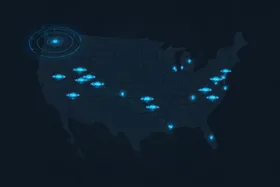
But there is a parallel track. The U.S. government’s All-domain Anomaly Resolution Office (AARO) now holds more than 2,000 active UAP cases. Roughly 40 percent remain unresolved after full review, according to the agency’s own reporting - meaning no known human-made object or natural phenomenon fits the documented characteristics. The Galileo Project, led by Harvard astrophysicist Avi Loeb and now advising the White House’s UAP Science Advisory Council, applies calibrated scientific instruments directly to the question of whether any of these cases represent non-human technology.
SETI looks outward for a signal across the cosmos. UAP investigators examine what may already be present here. Both are, ultimately, asking Fermi’s question.
If even a single one of those unresolved cases were definitively traced to non-human technology, the Fermi Paradox would be answered in an instant. The silence that Fermi noticed at lunch in 1950 would turn out not to be silence at all - merely a question of where we had been looking.
That is why the paradox is not merely a puzzle for astronomers. It is the question that gives every UAP investigation its deepest stakes.