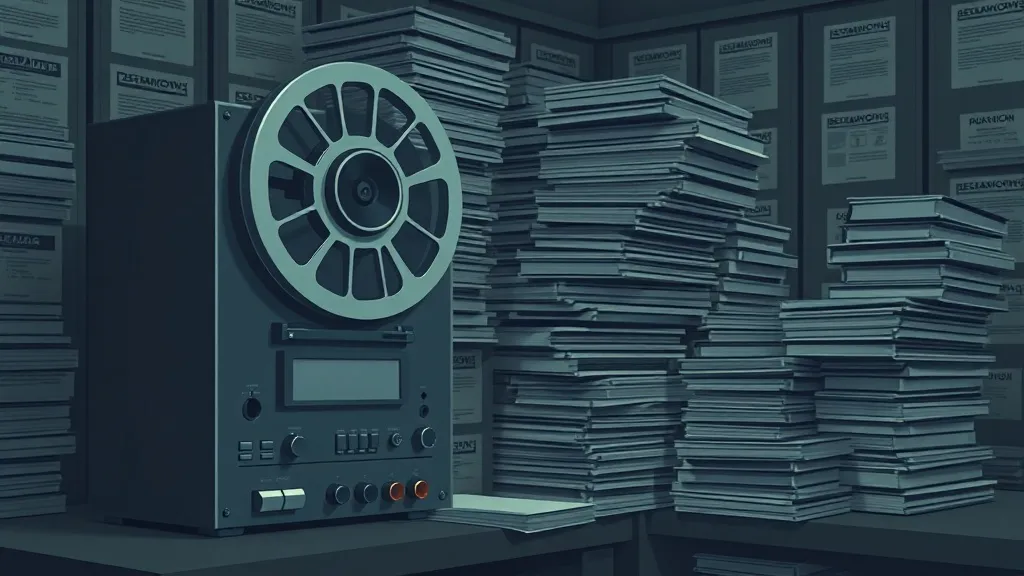
MIT Lincoln Laboratory has agreed to hand over a 74-year-old reel-to-reel recording of a military UFO briefing - identified by catalogue number - to congressional investigators within 30 days.
MIT Lincoln Laboratory has agreed to hand over a 74-year-old reel-to-reel recording of a military UFO briefing to congressional investigators, after Rep. Eric Burlison identified the specific film by its catalogue number and formally demanded its release. The laboratory’s attorneys acknowledged the file’s existence and said they would comply within 30 days, according to Burlison’s office.
The announcement, made by Burlison on June 24, 2026, adds another chapter to an ongoing congressional effort to retrieve UAP-related records held by private contractors and federally funded research institutions.
The Recording
The film is catalogued as “AF-ATIC-FILM, 03/52” and is labeled a “flying saucer talk.” According to Burlison’s letter to the institution, it features Edward J. Ruppelt as the briefer.
Ruppelt was the Air Force officer who led Project Blue Book - the military’s official program to investigate UFO reports, active from 1952 to 1969 - and is credited with coining the term “unidentified flying object.” A briefing film delivered by Ruppelt to scientists in 1952 would represent a primary-source record of how military investigators understood the subject at the time, before the official public narrative solidified around dismissal.
The recording’s connection to the Beacon Hill Study has also been noted. The Beacon Hill Study was a Cold War scientific assessment of U.S. air defense systems, involving researchers and defense specialists who were briefed on sensitive military programs. A March 1952 briefing delivered within that context would have reached people actively working on radar detection and threat assessment systems.
How Burlison Found It
Burlison, a Republican member of the House Oversight Committee from Missouri, has been systematically pressing federally funded research centers to account for UAP-related materials in their possession. He sent a similar demand to MITRE Corporation earlier in 2026, prompting the disclosure that MITRE’s own relevant records date back to 1930.
This time, his team went further - identifying the MIT Lincoln Lab recording by its specific catalogue designation before making contact.
“We told MIT Lincoln Labs we know the exact video file you are holding, by name, and we want it,” Burlison said. “They admitted it exists and agreed to turn it over.”
His office requested that the lab determine the recording’s current status, preserve the original material, and coordinate with the National Archives and Records Administration for archival review and long-term preservation. The 30-day compliance window would put any handover in late July 2026.
Why MIT Lincoln Laboratory?
MIT Lincoln Laboratory is a federally funded research and development center - an FFRDC - operated under contract to the Department of Defense but structured as part of a private institution. Unlike executive branch agencies, FFRDCs occupy a legal grey area with respect to congressional oversight and Freedom of Information Act requirements.
Burlison’s broader argument is that some historically significant UAP-related material may have moved through institutions like MIT Lincoln Lab precisely because that structure keeps it insulated from the usual mechanisms of public accountability. If that argument holds, the 1952 Ruppelt recording may not be an isolated case.
Historical Context: The 1952 Washington Overflights
A Ruppelt briefing from March 1952 takes on additional significance given what happened later that year. Over two consecutive weekends in July 1952, unidentified objects appeared repeatedly on radar over Washington, D.C. Multiple radar stations tracked the contacts simultaneously. Air Force jet interceptors were scrambled. Airline pilots and military personnel reported unusual lights moving in ways that exceeded what conventional aircraft of the era could achieve.
The events attracted significant national press attention and prompted an Air Force press conference - at the time, the largest held at the Pentagon since World War II.
The Air Force’s official explanation attributed the radar returns to atmospheric temperature inversions - a meteorological effect that can bend radar signals and create false contacts. That conclusion has been disputed by researchers and, notably, by Ruppelt himself in his 1956 memoir.
What Remains Unknown
The contents of the recording have not been released. No transcript, digitized version, or description of the film’s specific claims has been made public. MIT Lincoln Lab has not issued an independent statement, and no National Archives transfer has been announced.
Whether the film reveals anything beyond what is already documented in declassified Project Blue Book files - which the National Archives has held for decades - remains to be determined once the material is reviewed.
For UAP researchers and Cold War historians, however, a moving-image record of the military’s chief UFO investigator briefing defense scientists in 1952 would be a rare primary-source document: not a summary, not a redacted report, but an unmediated account of what Ruppelt said - and was permitted to say - in a room full of people with clearances.