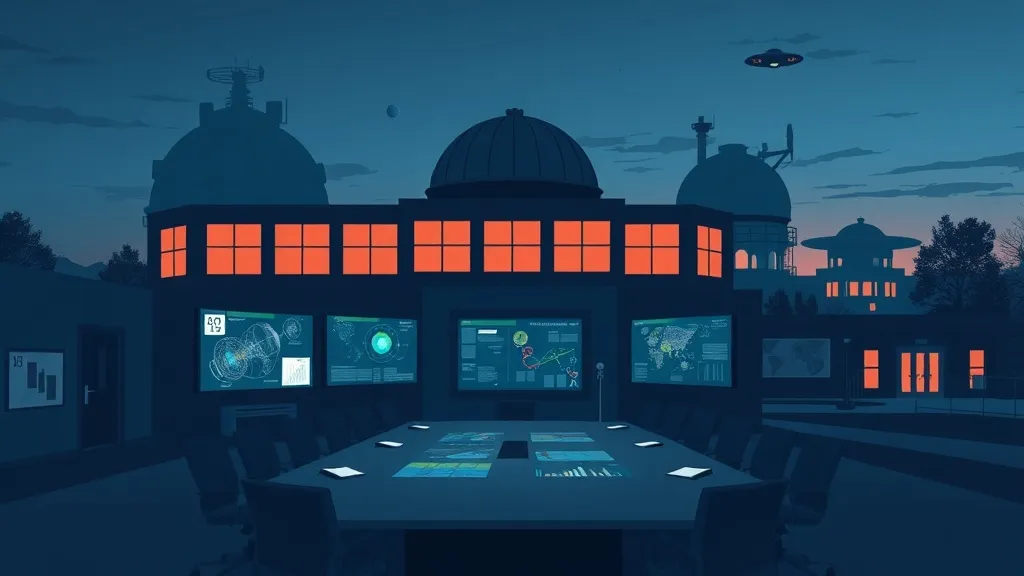
Harvard astrophysicist Avi Loeb has been tasked by the White House, AARO, and ODNI to lead a new advisory council - the first government-mandated scientific body focused on rigorous methodology in UAP research.
The White House, the Pentagon’s All-Domain Anomaly Resolution Office (AARO), and the Office of the Director of National Intelligence (ODNI) have formally asked Harvard astrophysicist Avi Loeb to assemble and chair a new UAP Science Advisory Council. The council, which also involves the FBI and other intelligence community partners, is tasked with bringing rigorous scientific methodology to the study of unidentified anomalous phenomena - with an explicit mandate to prioritise new, calibrated data collection over revisiting older material that cannot be independently verified.
Loeb announced the appointment on June 12, 2026, the same day the Pentagon posted its third batch of declassified UAP files through the PURSUE programme. He named five founding members: Dr. Richard Cloete and Dr. Regina Sarmiento, both specialising in data analysis and AI-assisted management; Prof. Matthew Szydagis, focused on instrumentation and data collection; Dr. Devesh Nandal, covering numerical analysis and astrophysics; and Dr. Omer Eldadi, bringing expertise in data management, AI, and human psychology.
What the council will - and will not - do
According to Loeb’s public statement, the council’s primary purpose is to help government agencies develop rigorous scientific frameworks for studying UAP, with particular emphasis on acquiring and analysing new, higher-quality data. The council will advise ODNI, AARO, the FBI, and other intelligence community members on determining the nature of UAP.
Notably, the council’s mandate explicitly does not include relitigating historical cases that cannot be independently verified. The reasoning, as Loeb has stated, is methodological: most legacy UAP records were not collected with scientific instrumentation in mind, and lack the sensor calibration data that would allow defensible scientific conclusions. The council’s value, in his view, lies in shaping how future encounters are documented rather than re-examining ambiguous archival material.
This approach mirrors Loeb’s long-standing position through the Galileo Project, the privately funded Harvard initiative he launched in 2021 to search for evidence of extraterrestrial technological objects using purpose-built scientific instruments. The difference is that the new council operates at the request of the U.S. government, with access to federal agencies and their data streams.
The agencies involved
The joint convening of the White House, AARO, and ODNI alongside the FBI and intelligence community is notable. AARO was established in 2022 under the National Defense Authorization Act as the Pentagon’s central hub for UAP reports from military and federal personnel. Its current director, Dr. Jon Kosloski, noted in a June 5 report - released as part of the third disclosure batch - that 40 percent of AARO’s active cases remain unresolved after investigation. The inclusion of civilian intelligence and scientific leadership in a single advisory structure marks a broadening of the UAP policy framework beyond its original military-intelligence remit.
Why this appointment is significant
Previous efforts to apply scientific oversight to UAP have been temporary or narrowly scoped. NASA’s independent UAP study team, convened in 2022 and which delivered its report in 2023, was a time-limited advisory exercise. The new council, by contrast, is described as an ongoing advisory body with a working relationship with multiple government agencies simultaneously.
Loeb told Newsmax on June 13 that the Pentagon’s most recent disclosure batch may carry a national security dimension, pointing to the unresolved percentage in AARO’s case load and the anomalous physical characteristics reported in some documented incidents. He did not specify which incidents he was referring to or provide additional evidence.
The parallel timing of the council’s announcement and the third UAP file release - which included 53 documents, six videos, and audio recordings from NASA missions - appears deliberate. Together, they signal a policy posture that combines transparency on existing data with investment in scientific infrastructure for future collection.
What remains unresolved
Several aspects of the council’s operation are not yet publicly documented. Its precise scope of authority has not been formally specified beyond “advisory.” The founding membership, while credentialled, is small, and it is not yet clear whether the council can expand, secure independent funding, or gain access to classified sensor data from military UAP encounters.
Whether a handful of academic scientists can shape operational data collection protocols across agencies as large as AARO and the intelligence community is an open question. The council’s effectiveness will ultimately depend on what access it is granted and whether its recommendations are adopted.
For now, the formation of the council is the most direct institutional step taken to place scientific methodology - rather than intelligence analysis alone - at the centre of how the U.S. government approaches the UAP question.